

GEO vs SEO: Complete Guide to AI Search vs Traditional Search
The way people search online has changed dramatically over the past few years. Traditional search engines are no longer the only place where users look for answers. AI-powered platforms such as ChatGPT, Gemini, Claude, Perplexity, and Google’s AI-powered search experiences are transforming how information is discovered and consumed. As a result, businesses, marketers, and publishers need to understand the difference between GEO vs SEO and why both matter in 2026.
For years, Search Engine Optimization (SEO) focused on helping websites rank higher on Google, Bing, and other search engines. Today, a new discipline known as Generative Engine Optimization (GEO) has emerged to help content become visible inside AI-generated answers.
GEO builds on SEO, enhancing your chances of appearing wherever users search, whether on Google, AI assistants, voice search, or generative platforms.
Before we dive in, let’s bridge the gap between traditional and AI search. In this complete guide, you’ll learn the key differences between GEO and SEO, how each works, when to use them, and how to build a future-proof content strategy that performs well across both traditional and AI search.
What Is SEO?
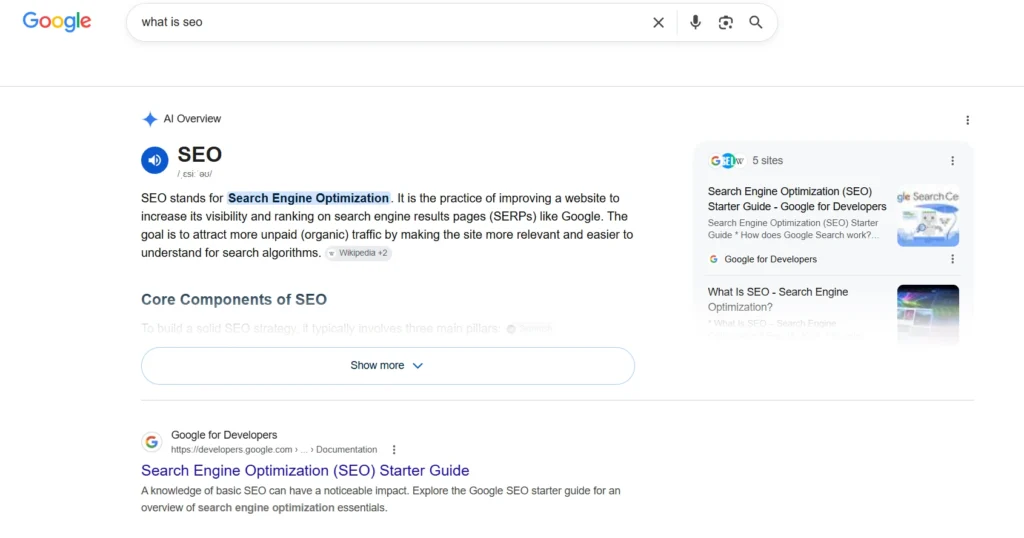
Search Engine Optimization (SEO) is the process of improving a website so that it ranks higher in traditional search engine results pages (SERPs).
The goal of SEO is simple:
- Increase organic traffic
- Improve visibility
- Generate qualified leads
- Build authority
- Increase conversions
When someone searches for:
- Best running shoes
- CRM software
- Personal injury lawyer
- Email marketing tools
Google analyzes billions of pages before deciding which results deserve the highest rankings.
SEO helps websites rank higher in search results.
Traditional SEO consists of several major areas:
Technical SEO
- Site speed
- Mobile friendliness
- Crawlability
- Indexing
- HTTPS
- Core Web Vitals
On-Page SEO
- Title tags
- Meta descriptions
- Heading hierarchy
- Keyword optimization
- Internal linking
- Content structure
Off-Page SEO
- Backlinks
- Brand mentions
- Digital PR
- Citations
Content SEO
Creating useful, comprehensive, and trustworthy content remains the foundation of successful SEO.
What Is GEO?
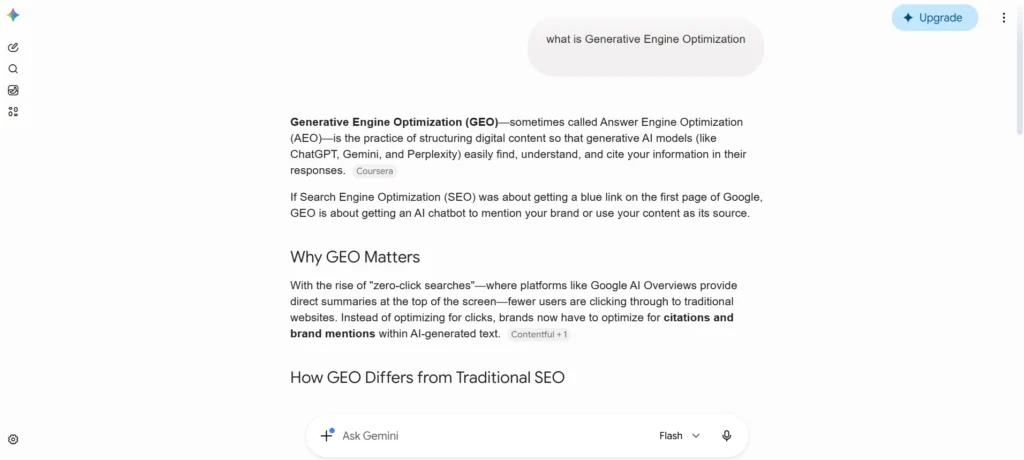
Generative Engine Optimization (GEO) is the practice of optimizing content so AI-powered search engines and assistants can not only find it but also recognize its reliability and usefulness, making it more likely to be directly cited or summarized within AI-generated answers. The unique value of GEO lies in helping content become part of the answers users see instantly, rather than requiring them to visit separate web pages.
Rather than simply aiming for top search rankings, GEO focuses on ensuring your information is frequently sourced and represented in AI-generated responses. This gives your content a prominent role in the digital conversation and increases your brand’s exposure even when users do not click through to a website.
These AI platforms include:
- ChatGPT
- Google Gemini
- Claude
- Microsoft Copilot
- Perplexity AI
- AI-powered search experiences
When users ask questions, these systems analyze trusted information from multiple sources before producing a direct answer.
Unlike traditional search engines, users often receive the complete answer without having to click multiple websites.
GEO is critical because it increases the likelihood that your trusted content is chosen by AI to appear directly in summarized answers, ensuring your brand’s knowledge and expertise reach users at the moment they seek information.
GEO vs SEO: Quick Comparison
| Feature | SEO | GEO |
| Primary Goal | Rank webpages | Become part of AI answers |
| Target | Google, Bing | AI search engines |
| Focus | Rankings | Citations and mentions |
| Success Metric | Organic traffic | AI visibility |
| Content Style | Keyword optimized | Context-rich and authoritative |
| User Journey | Click website | Receive direct answer |
| Optimization | Search algorithms | Large language models |
Although the goals differ, the underlying principle remains the same:
Create trustworthy content that genuinely helps users.
How Traditional Search Works
Traditional search engines follow several major steps.
Crawling
Bots discover webpages by following links across the internet.
Indexing
The search engine stores pages inside its massive database.
Ranking
When someone performs a search, hundreds of ranking signals determine which pages appear first.
These include:
- Content quality
- Relevance
- Page speed
- User experience
- Authority
- Backlinks
- Search intent
The highest-quality pages earn the top rankings.
How AI Search Works
AI search follows a different process.
Instead of displaying ten blue links, AI systems attempt to answer the user’s question immediately.
The AI typically:
- Understands the user’s intent
- Searches trusted sources
- Combines information
- Generates a conversational answer
- Sometimes cites original sources
Rather than asking:
“Which website ranks first?”
AI asks:
“Which sources provide the most reliable information?”
This subtle difference changes how content should be written.
Why GEO Exists
Traditional SEO was designed for search engines.
AI systems have different objectives.
They prioritize:
- Clear explanations
- Context
- Factual accuracy
- Authority
- Well-organized information
- Reliable sources
Instead of relying solely on keyword density, AI evaluates whether the content genuinely helps answer a question.
That is why GEO has become an essential extension of modern search optimization.
Major Differences Between GEO and SEO
1. Rankings vs Answers
SEO aims to place your page near the top of search results.
GEO aims to have your information included in AI-generated responses.
One focuses on rankings.
The other focuses on visibility inside conversations.
2. Keywords vs Context
Traditional SEO often begins with keyword research.
GEO begins with understanding the complete user question.
Instead of optimizing only for:
“Best laptops”
GEO also considers related questions like:
- Which laptop lasts longest?
- Which laptop is best for students?
- What laptop should I buy for under $1,000?
Context matters more than repetition.
3. Backlinks vs Trust Signals
Backlinks remain important for SEO.
AI systems also evaluate broader trust signals, including:
- Author expertise
- Brand reputation
- Factual consistency
- Source reliability
- Comprehensive coverage
This makes credibility more valuable than ever.
4. Clicks vs Visibility
SEO success is usually measured by:
- Organic sessions
- Rankings
- Click-through rate
- Conversions
GEO introduces additional metrics, such as:
- AI citations
- Brand mentions
- Reference frequency
- Visibility across AI assistants
Even if users never click your website, your brand can still gain exposure through AI-generated answers.
5. Search Intent vs Conversational Intent
Traditional searches were often short.
Examples include:
- Running shoes
- CRM software
- Tax calculator
Today’s AI prompts are much longer.
For example:
“What is the best CRM for a small construction company with fewer than 20 employees?”
This conversational behavior changes how content should be structured.
Is SEO Dead?
Absolutely not.
SEO remains one of the most effective digital marketing channels because billions of searches still happen on Google every day.
However, relying solely on SEO is no longer enough.
Businesses that ignore AI search may lose visibility as more users rely on conversational search experiences.
The future belongs to organizations that combine SEO and GEO instead of choosing one over the other.
How Google Is Changing Search
Google itself has embraced AI.
Features like Google AI overview demonstrate how search results are evolving beyond traditional blue links.
Instead of showing only webpages, Google increasingly provides AI-generated summaries that synthesize information from multiple trusted sources before users even click a result.
This shift makes authoritative, well-structured content even more important.
Which Is Better in 2026?
One of the most common questions marketers ask is whether they should invest in GEO or continue focusing on SEO. The answer isn’t about choosing one over the other; it’s about understanding how they complement each other.
SEO drives organic search traffic, while GEO enhances brand presence in AI-generated responses. Focusing only on SEO may miss AI opportunities; ignoring SEO still limits authority, as AI models rely on established websites.
Think of it this way:
- SEO helps users find your website.
- GEO helps AI find and trust your content.
The strongest digital marketing strategy in 2026 combines both approaches.
Why GEO Is Becoming More Important
AI-powered search is changing how people consume information.
Instead of reading several blog posts, users increasingly ask a single, detailed question and expect an instant, complete answer.
For example:
Instead of searching:
Best accounting software
Users now ask:
What is the best accounting software for a small business with fewer than ten employees and a limited budget?
AI systems analyze multiple trusted sources before generating a response.
If your content is detailed, accurate, and easy for AI to understand, your brand has a much better chance of being referenced.
How GEO and SEO Work Together
Many marketers mistakenly think GEO replaces SEO.
In reality, GEO relies on many of the same foundations as SEO.
A strong website should have:
- Fast loading pages
- Clear site architecture
- Helpful content
- Original research
- Trustworthy authors
- Logical heading structure
- Easy navigation
These elements improve both traditional rankings and AI visibility.
Rather than maintaining separate strategies, businesses should create content that satisfies both search engines and AI systems.
The Importance of High-Quality Content
Whether optimizing for Google or AI assistants, content quality remains the deciding factor.
High-performing content should:
- Answer the user’s question completely
- Include accurate information
- Cover the topic in depth
- Be easy to scan
- Use descriptive headings
- Include examples where appropriate
- Stay updated as information changes
AI systems favor content that demonstrates expertise instead of simply repeating keywords.
This makes comprehensive guides far more valuable than thin articles written solely for rankings.
Understanding User Intent
Successful SEO has always focused on search intent.
GEO expands this idea even further by emphasizing conversational intent.
For example, someone searching for “email marketing” may actually want to know:
- Which platform is easiest to use?
- Which software is most affordable?
- Which tool integrates with Shopify?
- Which platform is best for beginners?
A single comprehensive article that answers these related questions provides greater value than several short pages targeting individual keywords.
Build Topic Authority Instead of Single Articles
One article rarely establishes authority anymore.
Search engines and AI systems increasingly evaluate entire websites.
A website covering dozens of related topics demonstrates greater expertise than one publishing isolated posts.
For example, a digital marketing website could create content around:
- SEO fundamentals
- Technical SEO
- Keyword research
- Link building
- Content marketing
- AI search
- GEO optimization
- Local SEO
- Analytics
Together, these articles strengthen topical authority.
Why Trust Matters More Than Ever
Both search engines and AI platforms aim to deliver reliable information.
That’s why trust has become one of the strongest ranking signals.
Ways to improve trust include:
- Publishing original insights
- Citing reliable sources
- Keeping articles updated
- Displaying author information
- Explaining methodologies
- Correcting outdated information
- Avoiding exaggerated claims
Reliable content earns credibility over time, making it more likely to be referenced by AI systems.
The Role of Google E-E-A-T
One framework that continues to influence high-quality content is Google E-E-A-T, which stands for Experience, Expertise, Authoritativeness, and Trustworthiness.
Although it is not a direct ranking factor by itself, following these principles helps create content that aligns with what both search engines and users expect.
To improve E-E-A-T:
- Share first-hand experience where possible.
- Demonstrate subject expertise.
- Build authority through consistent publishing.
- Ensure every article is accurate and trustworthy.
These practices also increase the likelihood that AI systems recognize your content as a dependable source.
How to Optimize Content for GEO
Generative Engine Optimization requires a slightly different writing style than traditional SEO.
Here are some proven techniques.
Write Clear Answers
AI models prefer direct, well-written explanations.
Instead of vague introductions, answer the primary question early in the article.
Use Question-Based Headings
Many AI searches are conversational.
Include headings that answer common questions, such as:
- What is GEO?
- How does GEO work?
- Why is GEO important?
- Is GEO replacing SEO?
This structure helps both readers and AI systems navigate your content.
Cover the Entire Topic
Avoid writing articles that answer only one small question.
Comprehensive resources perform better because they satisfy multiple related search intents in one place.
Organize Information Logically
Break content into sections with:
- H2 headings
- H3 headings
- Bullet points
- Tables
- Step-by-step explanations
Well-organized content is easier for both humans and AI to understand.
Update Content Regularly
AI search evolves rapidly.
Refreshing your content with new examples, statistics, and best practices signals that your information remains relevant.
Common GEO Mistakes
Many websites struggle with GEO because they continue using outdated SEO tactics.
Common mistakes include:
- Publishing thin articles
- Keyword stuffing
- Ignoring search intent
- Writing for algorithms instead of people
- Covering topics superficially
- Failing to update old content
- Using misleading titles
These practices reduce credibility and make content less useful for AI-generated responses.
Should Small Businesses Care About GEO?
Absolutely.
AI search is not just for large brands.
Small businesses can benefit by publishing highly focused, trustworthy content that answers customer questions better than competitors.
A local business, for example, can create detailed guides about its products, services, pricing, and industry expertise. This increases the chances of appearing in both traditional search results and AI-generated recommendations.
Building Long-Term Authority
The future of search favors brands rather than isolated pages.
Businesses should consistently publish valuable content that demonstrates expertise over time.
For example, agencies such as Innovationegg build authority by consistently sharing insights, case studies, and educational resources rather than relying solely on promotional pages.
This long-term approach strengthens both search visibility and brand recognition.
Practical GEO + SEO Checklist for 2026
If you want your website to perform well in both traditional search engines and AI-powered search experiences, follow this checklist.
Technical Foundation
- Improve page loading speed.
- Ensure your website is mobile-friendly.
- Use HTTPS for secure browsing.
- Fix broken links and crawl errors.
- Submit an updated XML sitemap.
Content Optimization
- Answer the main question within the first few paragraphs.
- Use descriptive H2 and H3 headings.
- Write naturally instead of overusing keywords.
- Include examples, comparisons, and practical advice.
- Keep paragraphs concise and easy to scan.
Authority Building
- Publish original research whenever possible.
- Showcase real expertise and experience.
- Update older articles with current information.
- Earn backlinks from reputable websites.
- Maintain a consistent publishing schedule.
AI-Friendly Writing
- Answer related questions throughout the article.
- Use clear definitions and explanations.
- Organize information logically.
- Avoid vague or misleading claims.
- Focus on solving the reader’s problem rather than simply ranking for keywords.
Following these practices creates content that performs well for both search engines and AI assistants.
GEO vs SEO: Which Strategy Should Businesses Choose?
The answer depends on your goals, but for most organizations, the smartest approach is to combine both.
Choose SEO if your primary objective is:
- Increasing organic website traffic.
- Ranking for competitive keywords.
- Driving leads through search engines.
- Improving long-term visibility in traditional search.
Choose GEO if your goal is:
- Increasing brand visibility in AI-generated responses.
- Becoming a trusted source referenced by AI assistants.
- Reaching users who rely on conversational search.
- Preparing for the future of digital discovery.
The strongest strategy is not choosing one over the other; it is integrating both into a single content marketing plan.
The Future of Search Beyond 2026
Search will continue evolving over the coming years.
Several trends are already shaping the future:
More Conversational Queries
Users are asking longer, more detailed questions instead of typing short keywords. Content should be written to answer complete questions naturally.
Greater Personalization
AI systems are becoming better at understanding context, preferences, and previous interactions. Personalized search experiences are likely to become even more common.
Multimedia Search Growth
Images, videos, podcasts, and interactive content will play a larger role in search results. Businesses should diversify their content formats rather than rely solely on text.
Increased Importance of Brand Authority
As AI systems evaluate multiple sources before generating responses, trusted brands with a history of publishing reliable information will have a competitive advantage.
Continuous Content Updates
Freshness is becoming increasingly important. Regularly reviewing and updating content helps maintain relevance in both traditional and AI search.
Final Thoughts
The debate around GEO vs SEO is not about replacing one strategy with another. Instead, it reflects the evolution of search.
Traditional SEO remains essential for earning visibility in search engine results, driving organic traffic, and attracting potential customers. At the same time, Generative Engine Optimization is becoming increasingly valuable as AI assistants and conversational search platforms change how people discover information.
Businesses that invest in helpful, accurate, and authoritative content will be well positioned in both environments. Instead of chasing algorithms, focus on understanding your audience, answering their questions thoroughly, and building genuine trust.
Whether you’re a small business, an established enterprise, or a content publisher, your long-term success depends on creating resources that people and AI systems consider worth recommending.
For organizations looking to strengthen their online presence, professional SEO Services can help develop a strategy that combines technical optimization, authoritative content, and AI-ready best practices to stay competitive in the rapidly changing search landscape.
Common Questions About GEO vs SEO
Is GEO replacing SEO?
No. GEO complements SEO rather than replacing it. Traditional search engines continue to drive billions of searches, while AI search introduces an additional opportunity for visibility.
Can one article rank in Google and appear in AI answers?
Yes. A well-structured, authoritative article can rank in traditional search results and be referenced by AI systems if it provides accurate, comprehensive information.
Do keywords still matter?
Yes, but they should be used naturally. Modern search algorithms and AI models prioritize relevance, context, and user satisfaction over keyword repetition.
Is GEO only useful for large companies?
No. Small businesses, startups, publishers, and local organizations can all benefit from creating high-quality, trustworthy content that answers users’ questions effectively.
How often should content be updated?
Review important pages every few months or whenever significant industry changes occur. Keeping information current improves credibility and helps maintain visibility over time.
