

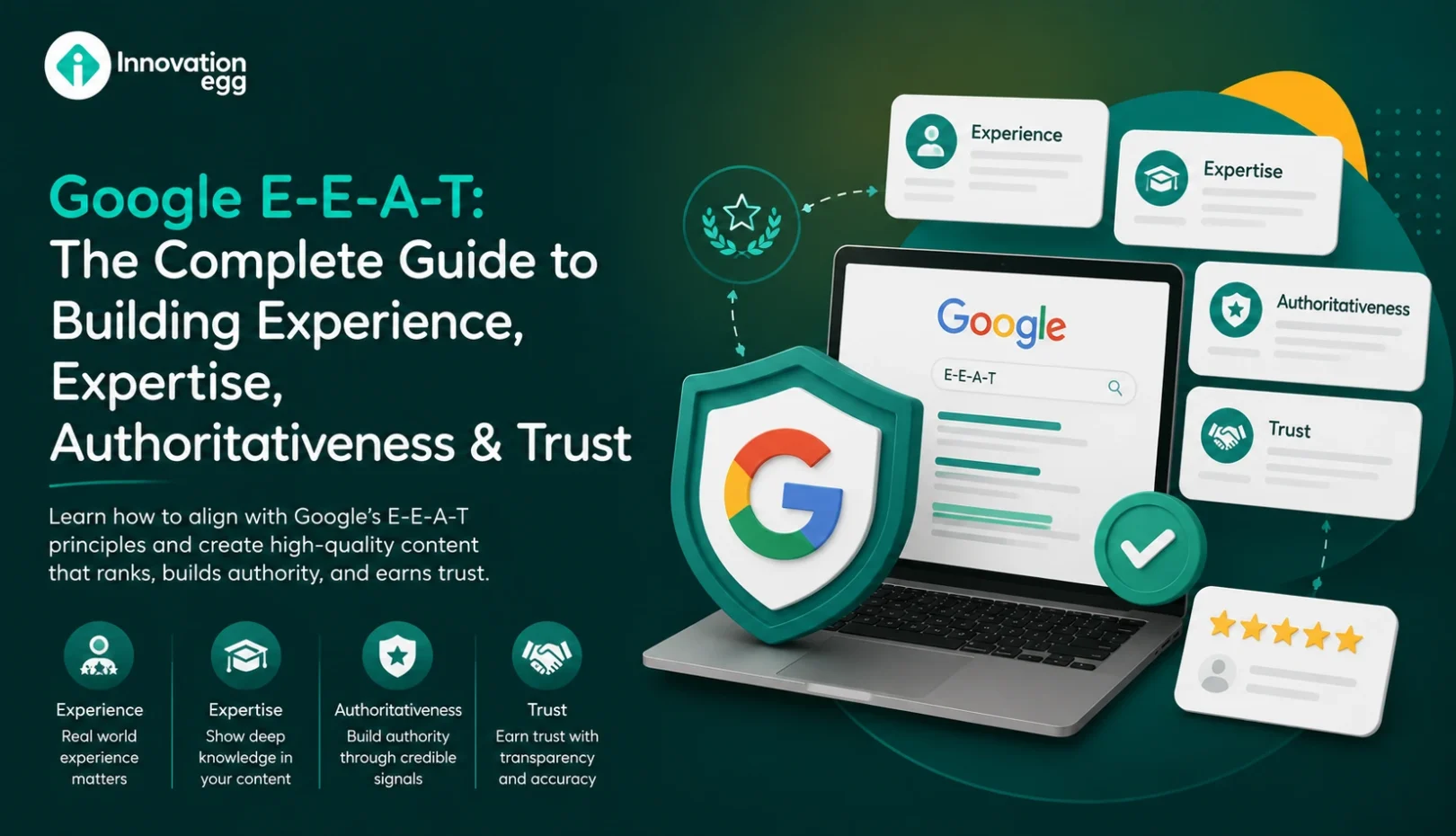
Google E-E-A-T: The Complete Guide to Building Experience, Expertise, Authoritativeness & Trust in 2026
Google Search has changed a lot over the past decade. Now, ranking well needs more than just keyword-filled content. Google evaluates content quality, credibility, and reliability with the E-E-A as a key factor.
E-E-A-T stands for Experience, Expertise, Authoritativeness, and Trustworthiness qualities that Google seeks in content. While not a direct ranking factor like page speed, E-E-A-T still shapes how Google’s algorithms assess content quality.
Whether you run a personal blog, an eCommerce store, a SaaS company, a healthcare website, or offer SEO Services, understanding E-E-A-T can help you build long-term search visibility and earn your audience’s confidence.
In this comprehensive guide, you’ll discover what E-E-A-T means, why it matters, and how to enhance each aspect to create content that excels in search results. Let’s first break down the fundamentals of E-E-A-T before exploring how to implement these qualities.
Table of Contents
- What Is Google E-E-A-T?
- Why Did Google Introduce E-E-A-T?
- Understanding Each Component of E-E-A-T
- Experience
- Expertise
- Authoritativeness
- Trustworthiness
- Why E-E-A-T Matters for SEO
- Is E-E-A-T a Direct Google Ranking Factor?
- Websites That Need E-E-A-T the Most
- Healthcare
- Finance
- Legal
- Education
- Travel
- How Google Evaluates E-E-A-T
- The Relationship Between Helpful Content and E-E-A-T
- 20 Proven Ways to Improve Your Website’s E-E-A-T
- Create Original Content Based on Real Experience
- Publish Comprehensive, In-Depth Articles
- Showcase Author Credentials
- Keep Content Updated
- Build Topical Authority
- Strengthen Internal Linking
- Earn High-Quality Backlinks
- Encourage Brand Mentions
- Improve Website Security
- Make Contact Information Easy to Find
- Display Transparent Policies
- Use Reliable Sources
- Add Original Images and Visuals
- Perform Regular Content Reviews
- Improve User Experience
- Build a Positive Online Reputation
- Demonstrate Real Results
- Be Honest About Limitations
- Invest in Your Brand
- Focus on Helping People First
- Common E-E-A-T Mistakes to Avoid
- E-E-A-T and AI Content
- How to Measure Your Website’s E-E-A-T
- E-E-A-T Checklist
- Does E-E-A-T Help Every Website?
- How E-E-A-T Fits Into Your Overall SEO Strategy
- Final Thoughts
- Frequently Asked Questions
- What does E-E-A-T stand for?
- Is E-E-A-T a ranking factor?
- How long does it take to improve E-E-A-T?
- Can new websites build E-E-A-T?
- Does AI-generated content hurt E-E-A-T?
- Why is trust the most important part of E-E-A-T?
What Is Google E-E-A-T?
E-E-A-T is a framework used by Google to evaluate the overall quality and credibility of web content. The acronym represents four essential qualities:
- Experience
- Expertise
- Authoritativeness
- Trustworthiness
Google introduced the additional “Experience” element in late 2022, expanding the previous E-A-T framework. This update emphasized that first-hand knowledge and real-world experience make content more valuable to users.
A traveler sharing firsthand experiences in Makkah gives users clearer, more authentic information than someone summarizing third-party content.
Similarly, someone who has personally used a software tool can write a more useful review than someone who has never interacted with it.
Why Did Google Introduce E-E-A-T?
Google’s mission has always been simple:
Deliver the most helpful and trustworthy information to users.
As millions of new pages are published every day, Google must determine which sources deserve visibility.
Anyone can publish online, but not everyone has genuine knowledge. E-E-A-T helps Google separate high-quality content from low-quality or copied info.
This is especially important for industries where inaccurate information can negatively affect people’s lives.
Examples include:
- Medical advice
- Financial guidance
- Legal information
- News reporting
- Government information
- Educational resources
Google refers to many of these as Your Money or Your Life (YMYL) topics.
Understanding Each Component of E-E-A-T
Experience
Experience refers to whether the content creator has actually performed, used, visited, tested, or experienced the topic firsthand.
Google increasingly values personal experience because it often produces more practical and trustworthy information.
Examples include:
- Reviewing a hotel after staying there
- Sharing your own SEO case study
- Documenting your Umrah journey
- Testing software before recommending it
- Writing product comparisons based on real usage
Real-life involvement answers questions better by sharing authentic, practical observations.
How to Demonstrate Experience
Include:
- Original photographs
- Screenshots
- Personal examples
- Case studies
- Test results
- Lessons learned
- Success stories
- Mistakes and improvements
These elements add value, setting your content apart from generic articles.
Expertise
Expertise focuses on the creator’s knowledge and skill within a subject.
Not every topic requires formal qualifications.
For example:
A professional doctor should write medical advice.
A certified financial advisor should explain investment strategies.
However, someone who has traveled extensively can provide excellent travel recommendations because of their practical expertise.
Google evaluates whether the person behind the content understands the subject deeply enough to provide accurate information.
Ways to Demonstrate Expertise
- Publish comprehensive articles.
- Use reliable references.
- Explain concepts clearly.
- Update outdated information.
- Avoid factual errors.
- Cover topics in depth.
- Answer common questions.
Expert content teaches through deep, original insight instead of repeating existing ideas.
Authoritativeness
Authority refers to your reputation within your industry.
A website becomes authoritative when other people recognize it as a trusted resource.
Authority comes from regular publishing, mentions by respected sites, quality backlinks, positive reviews, and brand recognition.
For example, if numerous marketing blogs cite Innovationegg as a trusted resource for SEO education, that strengthens its authority within the digital marketing industry.
Building authority takes time and consistency. It cannot be achieved instantly.
It grows through consistency, expertise, and trust.
Trustworthiness
Google considers Trustworthiness the most important element of E-E-A-T.
Without trust, experience and expertise lose much of their value.
Users should feel confident that:
- Information is accurate.
- The website is secure.
- Authors are identifiable.
- Sources are reliable.
- Contact information is available.
- Privacy policies are transparent.
Trust shapes every page of your website.
Even excellent articles lose credibility without site transparency.
Why E-E-A-T Matters for SEO
Search engines aim to provide users with the best possible answers.
When multiple pages target the same keyword, Google often favors websites that demonstrate stronger E-E-A-T signals.
Benefits include:
- Higher rankings
- Better user engagement
- Increased organic traffic
- More backlinks
- Stronger brand reputation
- Improved conversion rates
By focusing on E-E-A-T, your content stays valuable regardless of algorithm changes.
Is E-E-A-T a Direct Google Ranking Factor?
This is one of the most common questions in SEO.
The answer is:
No, E-E-A-T itself is not a direct ranking factor.
Google does not assign a numerical E-E-A-T score to websites.
Instead, Google’s algorithms evaluate many signals that reflect these qualities.
Examples include:
- Author reputation
- Content quality
- Website security
- User engagement
- Citations
- Backlinks
- Brand mentions
- Content freshness
These signals, together, help Google judge whether a page deserves visibility.
Websites That Need E-E-A-T the Most
Although every website benefits from E-E-A-T, some industries require especially high standards.
These include:
Healthcare
Incorrect medical information can seriously affect people’s health.
Healthcare websites should feature licensed professionals, evidence-based content, and regular updates.
Finance
Financial advice influences important life decisions.
Financial advice demands the greatest care for accuracy and transparency.
Legal
Legal guidance must come from qualified professionals with verified expertise.
Education
Educational resources should be accurate, well-researched, and easy to verify.
Travel
Travel websites benefit greatly from personal experience, original photos, destination guides, and practical advice.
Readers appreciate recommendations from people who have actually visited the places they describe.
How Google Evaluates E-E-A-T
Google uses numerous quality signals rather than relying on a single metric.
Some of the most important include:
- Author credentials
- Content originality
- Backlink profile
- Brand reputation
- User satisfaction
- Helpful content
- Website security
- Accurate citations
- Transparent business information
- Positive online mentions
These signals work together to help Google’s systems identify trustworthy websites.
The Relationship Between Helpful Content and E-E-A-T
Google’s Helpful Content System encourages creators to produce content for people, not search engines.
Helpful content naturally aligns with E-E-A-T because it:
- Solves real problems.
- Reflects real-world experience.
- Gives original, first-hand perspectives.
- Answers users’ questions completely.
- Delivers useful, actionable answers.
Instead of publishing dozens of thin articles, focus on creating fewer, more comprehensive resources that genuinely help readers. Take action now by reviewing your existing content and updating it to better serve your audience.
20 Proven Ways to Improve Your Website’s E-E-A-T
Building E-E-A-T requires valuable, ongoing content, earned credibility, and a trustworthy online presence. The strategies below strengthen your site over time.
1. Create Original Content Based on Real Experience
One of the biggest differences between average content and exceptional content is originality.
Instead of rewriting what already exists, publish insights that come from personal experience, testing, research, or practical application.
For example, if you’ve tested an SEO strategy, share:
- What you did
- Why did you do it
- The challenges you faced
- The results you achieved
- Lessons you learned
Such content is hard to copy and delivers readers real, irreplaceable value.
2. Publish Comprehensive, In-Depth Articles
Google increasingly rewards content that thoroughly answers a topic.
Rather than writing several short posts covering fragments of a subject, create complete guides that explain:
- Definitions
- Benefits
- Challenges
- Best practices
- Examples
- Common mistakes
- Frequently asked questions
Comprehensive articles retain users longer by providing all necessary information in one place.
3. Showcase Author Credentials
Readers want to know who created the content they’re consuming.
Every article should clearly identify its author and explain why that person is qualified to write about the topic.
A strong author bio may include:
- Professional experience
- Certifications
- Areas of specialization
- Industry achievements
- Publications
- Speaking engagements
- Relevant projects
This transparency builds confidence with both users and search engines.
4. Keep Content Updated
Information quickly becomes outdated, especially in industries like SEO, technology, finance, and healthcare.
Review older articles regularly and update:
- Statistics
- Screenshots
- Best practices
- Tools
- References
- Examples
- Dates
- Recommendations
Fresh content signals that your website remains active and reliable.
5. Build Topical Authority
Instead of covering hundreds of unrelated topics, focus on becoming an expert in a specific niche.
For example, if your website focuses on SEO, create interconnected articles covering:
- Technical SEO
- Keyword research
- Link building
- Local SEO
- Content optimization
- Core Web Vitals
- Schema markup
- Google updates
- E-E-A-T
The more comprehensive your coverage, the stronger your topical authority becomes.
6. Strengthen Internal Linking
Internal links help users discover related information while helping search engines understand your site’s structure.
Every article should naturally connect to other relevant pages.
Benefits include:
- Better crawlability
- Improved user experience
- Increased page views
- Stronger topical relevance
- More efficient distribution of authority across your website
7. Earn High-Quality Backlinks
Backlinks remain one of the strongest signals of authority.
However, quality matters far more than quantity.
Focus on earning links from:
- Industry publications
- Universities
- Government organizations
- Well-known blogs
- Trusted media websites
Avoid purchasing low-quality links or participating in manipulative link schemes.
8. Encourage Brand Mentions
Even when another website doesn’t link directly to you, mentioning your brand contributes to your overall online reputation.
As your website gains recognition through interviews, collaborations, podcasts, webinars, conferences, and industry discussions, your authority naturally grows.
9. Improve Website Security
Trust begins with security.
Your website should include:
- HTTPS encryption
- Secure payment methods (if applicable)
- Updated software
- Malware protection
- Strong passwords
- Two-factor authentication for administrators
Visitors are more likely to trust a secure website than one displaying browser security warnings.
10. Make Contact Information Easy to Find
Legitimate businesses are transparent.
Include:
- Contact page
- Email address
- Business location (if applicable)
- Contact form
- Social media profiles
- Customer support information
Users should never struggle to find ways to contact your organization.
11. Display Transparent Policies
Trust increases when visitors understand how your website operates.
Important pages include:
- Privacy Policy
- Terms and Conditions
- Disclaimer
- Cookie Policy
- Refund Policy (if selling products or services)
These pages demonstrate professionalism and accountability.
12. Use Reliable Sources
Support important claims with reputable references whenever appropriate.
Examples include:
- Academic research
- Government publications
- Official company documentation
- Industry reports
- Peer-reviewed studies
Accurate sourcing strengthens your credibility and reassures readers.
13. Add Original Images and Visuals
Unique visuals increase both user engagement and perceived authenticity.
Consider including:
- Original photography
- Infographics
- Charts
- Screenshots
- Process diagrams
- Comparison tables
Visual evidence reinforces your experience and makes complex topics easier to understand.
14. Perform Regular Content Reviews
As your website grows, some articles may become outdated, inaccurate, or less relevant.
Conduct regular content reviews to:
- Update statistics
- Improve readability
- Remove outdated advice
- Fix broken links
- Expand thin content
- Consolidate overlapping articles
Many website owners include a periodic SEO audit as part of their maintenance process to identify technical issues, outdated pages, and opportunities for improvement.
15. Improve User Experience
A trustworthy website should also be easy to use.
Focus on:
- Fast loading speed
- Mobile responsiveness
- Clear navigation
- Readable typography
- Logical page structure
- Accessible design
Visitors who enjoy using your website are more likely to stay longer and return.
16. Build a Positive Online Reputation
Your reputation extends beyond your own website.
Encourage satisfied customers to leave reviews on trusted platforms and respond professionally to feedback.
Positive reviews, testimonials, and recommendations all strengthen trust signals.
17. Demonstrate Real Results
Whenever possible, back up your advice with measurable outcomes.
Examples include:
- Before-and-after case studies
- Traffic growth
- Conversion improvements
- Revenue increases
- Performance comparisons
- Campaign success stories
Real-world evidence is far more convincing than theoretical claims.
18. Be Honest About Limitations
Not every strategy works for every website.
Explain:
- When a technique is appropriate
- Potential risks
- Alternative approaches
- Common challenges
Balanced content often appears more trustworthy than articles claiming guaranteed success.
19. Invest in Your Brand
Strong brands naturally earn more trust.
Maintain consistency:
- Logo
- Colors
- Messaging
- Tone of voice
- Content quality
- Publishing schedule
Brand consistency helps users recognize and remember your website.
20. Focus on Helping People First
The most successful websites prioritize users over search engines.
Before publishing any article, ask yourself:
- Does this solve a real problem?
- Would I trust this advice?
- Is the information complete?
- Have I shared something original?
- Does it genuinely help the reader?
If the answer is yes, you’re already moving in the right direction.
Common E-E-A-T Mistakes to Avoid
Even experienced website owners can weaken their credibility by making avoidable mistakes.
Watch out for these common issues:
- Publishing AI-generated content without reviewing it
- Copying competitors’ articles
- Using misleading headlines
- Hiding author information
- Ignoring factual accuracy
- Overusing keywords
- Making unsupported claims
- Neglecting content updates
- Building spammy backlinks
- Prioritizing search engines over readers
Avoiding these mistakes helps preserve both your rankings and your reputation.
E-E-A-T and AI Content
Artificial intelligence has transformed content creation, but using AI responsibly is essential.
AI can help with:
- Research
- Outlines
- Brainstorming
- Grammar improvements
- Draft generation
However, AI should not replace genuine expertise or first-hand experience.
The most effective content combines AI-assisted efficiency with human knowledge, editing, and insight. Readers and search engines benefit most when articles reflect genuine understanding rather than merely automated text.
How to Measure Your Website’s E-E-A-T
Unlike page speed or Core Web Vitals, there isn’t a single score that measures E-E-A-T. Instead, you should evaluate several indicators that reflect your website’s credibility and quality.
Here are some metrics worth monitoring:
- Organic traffic growth
- Keyword rankings
- Average engagement time
- Bounce rate
- Returning visitors
- High-quality backlinks
- Brand mentions
- Positive reviews
- Conversion rate
- Social shares
- Direct traffic
When these metrics improve consistently, it’s often a sign that your website is becoming more trustworthy and authoritative in the eyes of both users and search engines.
E-E-A-T Checklist
Use this checklist before publishing any new article.
Experience
- Have I written from personal experience?
- Did I include original examples or case studies?
- Are screenshots or photos included where appropriate?
Expertise
- Is the information accurate?
- Have I explained the topic thoroughly?
- Does the article answer common questions?
Authoritativeness
- Is the article linked to other relevant content?
- Have I cited reliable sources where necessary?
- Does the website demonstrate expertise in this topic?
Trustworthiness
- Is the page secure (HTTPS)?
- Is the author clearly identified?
- Are there contact details and policy pages?
- Is the information honest and unbiased?
If you can confidently answer “Yes” to these questions, your content is well-positioned to meet Google’s quality expectations.
Does E-E-A-T Help Every Website?
Yes. Although E-E-A-T is especially important for Your Money or Your Life (YMYL) websites, every website benefits from demonstrating credibility.
Whether you operate:
- A travel blog
- An online store
- A SaaS business
- A local business website
- A news publication
- A marketing agency
- A portfolio website
Building trust encourages users to spend more time on your website, return in the future, and recommend your content to others.
How E-E-A-T Fits Into Your Overall SEO Strategy
E-E-A-T should not be viewed as a standalone tactic. Instead, it complements every other aspect of search engine optimization.
A successful SEO strategy combines:
- High-quality content
- Technical optimization
- Fast website performance
- Mobile-friendly design
- Strong internal linking
- Quality backlinks
- Positive user experience
- Consistent publishing
- Brand building
- Trust signals
When these elements work together, they create a website that is valuable to users and easier for search engines to understand and recommend.
Final Thoughts
Google’s approach to ranking websites continues to evolve, but one principle remains consistent: the best content is created for people.
E-E-A-T encourages website owners to move beyond keyword optimization and focus on delivering authentic value through real experience, proven expertise, established authority, and lasting trust. These qualities not only improve search visibility but also help build stronger relationships with readers.
Instead of chasing short-term ranking tricks, invest in creating content that educates, solves problems, and reflects genuine knowledge. Over time, this approach strengthens your brand, earns user confidence, and supports sustainable organic growth.
If you’re looking for inspiration from the top digital marketing agencies in the USA, one common trait you’ll notice is their commitment to publishing trustworthy, experience-driven content that addresses user needs rather than simply targeting keywords. Adopting the same mindset can help any website compete more effectively in today’s search landscape.
Frequently Asked Questions
What does E-E-A-T stand for?
E-E-A-T stands for Experience, Expertise, Authoritativeness, and Trustworthiness. It is Google’s framework for evaluating the overall quality and credibility of web content.
Is E-E-A-T a ranking factor?
Not directly. Google has stated that E-E-A-T itself is not a measurable ranking factor, but many of the signals associated with it—such as content quality, reputation, and trust—are reflected in its ranking systems.
How long does it take to improve E-E-A-T?
Improving E-E-A-T is an ongoing process. Depending on your niche and competition, noticeable improvements may take several months of consistently publishing high-quality content and building your website’s reputation.
Can new websites build E-E-A-T?
Yes. New websites can establish strong E-E-A-T by publishing original content, demonstrating genuine expertise, maintaining transparency, and consistently helping users solve real problems.
Does AI-generated content hurt E-E-A-T?
Not necessarily. Google focuses on the quality and usefulness of content rather than how it was created. AI-generated content should always be reviewed, edited, fact-checked, and enhanced with human expertise and original insights.
Why is trust the most important part of E-E-A-T?
Without trust, users are unlikely to rely on your content or return to your website. Google also emphasizes trust because accurate and reliable information creates a better search experience for everyone.
