

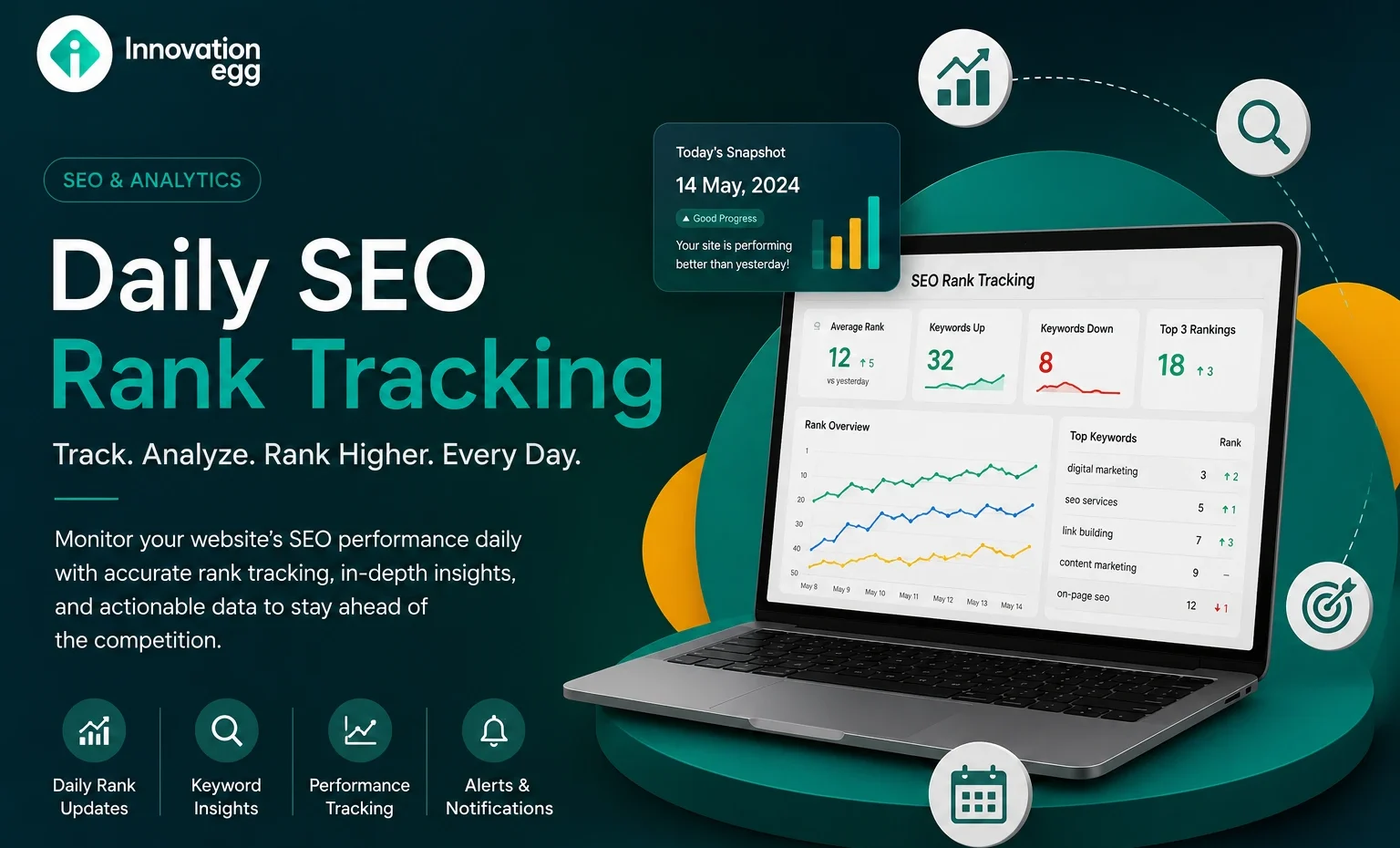
Daily SEO Rank Tracking: The Complete Guide to Monitoring Keyword Performance in 2026
Imagine waking up to find your website has lost half its organic traffic overnight. Without daily keyword monitoring, you might not notice until it’s too late. Competitors could claim your rankings, and regaining visibility could take months.
SEO has changed dramatically in 2026. AI-powered search, frequent algorithm updates, personalized results, and rising competition mean rankings shift faster than in prior years. Businesses tracking weekly or monthly risk are missing key warnings.
Daily SEO rank tracking lets marketers, business owners, and SEO pros monitor keyword performance, spot ranking changes early, measure campaign impact, and act before small problems cause big traffic losses.
Google handles billions of daily searches, offering huge potential for businesses. These opportunities only matter if your website consistently ranks well in search results.
In this comprehensive guide, you’ll learn:
- What daily SEO rank tracking is
- Why it matters in 2026
- How Google rankings change
- The key metrics every SEO professional should monitor
- The best rank tracking tools
- Common mistakes to avoid
- Proven strategies to improve your rankings over time
Whether you manage a personal blog, an eCommerce store, or enterprise websites, mastering daily rank tracking can become one of the most valuable habits in your SEO strategy. With that foundation, let’s look more closely at what daily SEO rank tracking really entails.
Table of Contents
- What Is Daily SEO Rank Tracking?
- Why Daily Keyword Monitoring Matters
- How Google Rankings Change Every Day
- Benefits of Daily SEO Rank Tracking
- Expert Insight: Why Daily Tracking Wins
- Key Metrics You Should Monitor
- Local SEO Rank Tracking
- Daily vs Weekly Rank Tracking
- Daily SEO Rank Tracking Checklist
- How Daily Rank Tracking Supports Your SEO Strategy
- Common Mistakes in Rank Tracking
- Best Tools for Daily SEO Rank Tracking
- How Artificial Intelligence Is Transforming Rank Tracking
- Choosing the Right Rank Tracking Strategy
- Advanced Tips for Better Daily SEO Rank Tracking
- Why More Businesses Are Investing in Daily Rank Tracking
- Conclusion
- Frequently Asked Questions
What Is Daily SEO Rank Tracking?
Daily SEO rank tracking is the process of monitoring where your website appears in search engine results pages (SERPs) for your target keywords. Instead of manually searching Google or checking rankings occasionally, specialized SEO tools automatically collect and record ranking data across multiple devices, locations, and search engines.
This continuous monitoring creates a historical record of keyword performance, allowing you to identify trends that would otherwise go unnoticed.
Modern rank-tracking platforms monitor far more than just keyword positions. They also track:
- Keyword position changes
- Search visibility
- SERP features
- Competitor rankings
- Local search performance
- Device-specific rankings
- Historical ranking trends
- AI Overview appearances
Rather than relying on assumptions, daily tracking provides accurate data to support better SEO decisions.
Why Daily Keyword Monitoring Matters
Most website owners notice SEO problems only after traffic falls. Rankings may drop quickly due to algorithm changes, competitor moves, technical issues, or new user behaviors.
Daily ranking checks help you: Spot drops before big traffic losses.
- Measure whether optimization efforts are producing results.
- Understand how Google updates affect your website.
- Discover new keyword opportunities.
- Monitor competitors more effectively.
- Prioritize SEO tasks based on real performance data.
- Identify pages that require immediate attention.
Daily monitoring doesn’t mean reacting to every fluctuation. It lets you recognize trends and respond early.
How Google Rankings Change Every Day
Many assume Google rankings are stable for weeks. In reality, search results change constantly.
Several factors contribute to daily ranking changes.
Algorithm Updates
Google releases improvements to its ranking systems throughout the year. Some updates are officially announced, while many smaller adjustments occur without public notice.
Even minor updates can shift rankings across all industries.
Competitor Activity
Competitors keep publishing content, earning links, boosting site speed, and updating pages.
If competitors update their pages while yours remain unchanged, your rankings may decline over time.
Search Intent Evolution
Google continuously improves its understanding of what users actually want.
If search intent evolves, Google may reorder results even if your content hasn’t changed.
Fresh Content
Google often rewards recently updated or newly published pages, particularly for topics that require current information.
Refreshing outdated articles can sometimes lead to significant improvements in ranking.
Technical Website Issues
Sudden technical issues can instantly impact rankings.
Examples include:
- Broken pages
- Indexing errors
- Server downtime
- Slow page speed
- Crawl issues
- Redirect problems
Daily monitoring finds these issues before they cause major traffic losses.
Benefits of Daily SEO Rank Tracking
Better Decision Making
Daily ranking data removes guesswork. SEO professionals see which pages need attention.
Faster Problem Detection
Ranking losses often happen before traffic dips.
Early detection lets businesses fix causes before revenue drops.
Improved Campaign Measurement
Whether you’ve updated content, built backlinks, or improved on-page SEO, daily tracking measures their impact over time.
You can evaluate performance much sooner, not just monthly.
Stronger Competitor Analysis
Monitoring competitors daily reveals:
- New keyword opportunities
- Emerging competitors
- Content gaps
- Visibility trends
- SERP changes
This information helps refine your own SEO strategy.
Better Reporting
Historical data yields more meaningful stakeholder reports.
Daily tracking shows visual trends, not just isolated ranking data, to demonstrate long-term progress.
Expert Insight: Why Daily Tracking Wins
One consistent pattern across successful SEO campaigns is that websites that monitor rankings daily recover from ranking losses much faster than those that check performance only once per month.
Daily tracking doesn’t guarantee higher rankings on its own. However, it significantly reduces the time between identifying a problem and solving it.
If a top keyword drops from position 3 to 11, daily monitoring lets your team investigate right away. Waiting weeks could cost traffic, leads, and revenue before anyone notices.
Top SEO teams use rank tracking as an early warning, not just a report.
Key Metrics You Should Monitor
Keyword positions alone don’t paint the full picture of your SEO. Analyze multiple metrics for complete insights.
Average Position
Average position shows where your tracked keywords rank in search engine results over a specific period.
Instead of focusing on a single keyword, average position reveals overall visibility and can change direction.
Search Visibility Score
Visibility Score estimates your site’s exposure by search volume and rankings of your keywords.
A growing visibility score generally indicates that your SEO efforts are moving in the right direction.
Ranking Distribution
Instead of tracking keywords individually, review how many fit each rank range.
For example:
| Ranking Position | Importance |
| Top 3 | Highest click-through potential |
| Top 10 | First-page visibility |
| Top 20 | Good improvement opportunity |
| Below 20 | Requires optimization |
This overview makes it easier to prioritize SEO tasks.
Organic Click Potential
Ranking first for a low-volume keyword is less valuable than ranking fifth for a high-volume one.
Always assess rankings with estimated organic traffic data.
SERP Features
Modern search shows more than blue links.
Monitor whether your pages appear in:
- Featured Snippets
- AI Overviews
- Image Packs
- Video Results
- People Also Ask
- Local Packs
- Knowledge Panels
Winning SERP features can drive more clicks than moving up one position.
Competitor Rankings
Your rankings aren’t in isolation.
Monitor:
- Which competitors gained positions
- Which pages outrank yours
- New competitors entering your niche
- Competitor content updates
Tracking competitors helps uncover new optimization opportunities.
Desktop vs Mobile Rankings
Search rankings differ between desktop and mobile.
Google evaluates websites using several mobile-specific signals, including:
- Responsive design
- Loading speed
- User experience
- Navigation
- Core Web Vitals
- Touch-friendly interface
A page ranking second on desktop may be seventh on mobile.
With more users on smartphones, monitor mobile SEO along with desktop for complete visibility.
Local SEO Rank Tracking
Businesses serving specific cities or regions should monitor location-based rankings rather than relying solely on national search results.
For example:
- Dentist near me
- Best coffee shop in London
- Roofing company Manchester
- SEO consultant Birmingham
These searches produce different results depending on the user’s location.
Local rank tracking helps businesses:
- Measure visibility within target cities
- Monitor Google Business Profile performance
- Compare rankings across multiple locations
- Identify new local competitors
- Improve location-specific landing pages
For local businesses, local tracking usually beats national monitoring alone.
Daily vs Weekly Rank Tracking
Many businesses wonder whether daily monitoring is necessary.
The comparison below highlights the differences.
| Feature | Daily Tracking | Weekly Tracking |
| Detect ranking drops | Immediate | Delayed |
| Measure SEO updates | Accurate | Less precise |
| Competitor monitoring | Continuous | Limited |
| Historical trends | Detailed | Less data |
| Technical issue detection | Faster | Slower |
| Reporting accuracy | High | Moderate |
While weekly reports are useful for reviewing progress, daily data collection provides much richer insights.
Daily SEO Rank Tracking Checklist
Use this checklist to stay on top of your rankings every day.
Review your highest-priority keywords.
Monitor ranking fluctuations.
Compare desktop and mobile rankings.
Check competitor movements.
Monitor AI Overview appearances.
Review Search Console performance.
Look for unexpected traffic changes.
Investigate significant ranking drops.
Update historical tracking records.
Prioritize pages requiring optimization.
Following a consistent routine helps you identify problems early and maintain steady SEO growth.
How Daily Rank Tracking Supports Your SEO Strategy
Ranking reports become valuable only when they guide meaningful action.
Use daily data to:
- Refresh declining content.
- Improve internal linking.
- Update outdated information.
- Fix technical SEO issues.
- Improve page speed.
- Strengthen topical authority.
- Expand high-performing content.
- Build stronger backlink profiles.
- Optimize click-through rates.
- Discover emerging keyword opportunities.
Every optimization should be measured against ranking improvements over time.
One of the most effective strategies is combining daily tracking with comprehensive keyword research to identify high-value opportunities and measure how new content performs after publication.
Common Mistakes in Rank Tracking
Even experienced SEO professionals sometimes misinterpret ranking data.
Avoid these common mistakes.
Checking Rankings Manually
Google personalizes search results based on location, search history, and device.
Manual searches rarely reflect true rankings.
Always rely on professional tracking tools.
Tracking Too Few Keywords
Monitoring only a handful of keywords provides an incomplete picture.
Track:
- Primary keywords
- Secondary keywords
- Long-tail keywords
- Local keywords
- Branded keywords
A broader keyword set reveals stronger trends.
Ignoring Search Intent
A ranking increase doesn’t always translate into more traffic.
If Google changes the intent behind a search query, rankings alone won’t tell the whole story.
Always evaluate rankings alongside clicks and conversions.
Reacting to Every Small Fluctuation
Minor daily changes are completely normal.
Instead of making immediate adjustments after every movement, focus on consistent trends over one or two weeks before taking major action.
Measuring Rankings Without Business Goals
Higher rankings are valuable only when they contribute to meaningful outcomes.
Always connect ranking improvements with:
- Organic traffic
- Lead generation
- Sales
- Revenue
- Conversion rates
SEO success should ultimately support business growth.
Best Tools for Daily SEO Rank Tracking
The right rank tracking tool depends on your budget, business size, and reporting requirements. While every platform offers keyword monitoring, the best tools provide additional insights such as competitor analysis, SERP features, historical trends, and location-based tracking.
Here are some of the most reliable options in 2026.
Ahrefs
Ahrefs is one of the most trusted SEO platforms for monitoring keyword rankings and analyzing competitors. It provides daily updates, detailed historical data, backlink analysis, and keyword research capabilities within a single dashboard.
Best for:
- Agencies
- SEO professionals
- Large websites
Semrush
Semrush offers comprehensive position tracking alongside site audits, competitor research, and content optimization tools.
Its customizable reports make it an excellent choice for businesses managing multiple projects.
Best for:
- Marketing teams
- Enterprise businesses
- SEO consultants
AccuRanker
AccuRanker focuses almost entirely on keyword tracking, making it one of the fastest and most accurate rank trackers available.
It provides instant updates, competitor comparisons, and advanced filtering options.
Best for:
- Agencies
- Large keyword portfolios
SE Ranking
SE Ranking delivers an excellent balance between affordability and features.
Users can monitor rankings across different countries, cities, and devices while accessing website audits and competitor analysis.
Best for:
- Small businesses
- Freelancers
- Growing websites
Mangools SERPWatcher
SERPWatcher offers a clean, beginner-friendly interface without sacrificing key ranking insights.
It’s particularly useful for website owners who need reliable daily tracking without an overwhelming number of features.
Best for:
- Beginners
- Bloggers
- Small businesses
Google Search Console
Although Google Search Console doesn’t provide real-time keyword positions, it remains an essential SEO tool.
It offers valuable insights into:
- Search impressions
- Clicks
- Average positions
- Click-through rate
- Indexing status
Combining Search Console with a dedicated rank tracker provides a much more complete understanding of SEO performance.
How Artificial Intelligence Is Transforming Rank Tracking
Artificial intelligence is changing how SEO professionals analyze ranking data.
Instead of manually reviewing thousands of keywords, modern SEO platforms now use AI to identify meaningful patterns and automatically recommend actions.
Today’s AI-powered tools can:
- Predict potential ranking changes.
- Detects algorithm impacts automatically.
- Identify optimization opportunities.
- Forecast keyword trends.
- Prioritize high-impact SEO tasks.
- Generate easy-to-understand performance summaries.
- Highlight pages at risk of losing rankings.
Rather than replacing SEO professionals, AI allows them to spend less time collecting data and more time making strategic decisions that improve search visibility.
Choosing the Right Rank Tracking Strategy
Tracking rankings every day is only valuable if your strategy supports meaningful action.
A successful rank tracking workflow should include:
- Daily automated keyword monitoring.
- Desktop and mobile tracking.
- Local search tracking where applicable.
- Competitor benchmarking.
- Historical ranking analysis.
- SERP feature monitoring.
- Weekly performance reviews.
- Monthly strategic reporting.
- Clear optimization priorities.
Remember, collecting data alone won’t improve rankings. Consistently acting on that data is what produces long-term SEO success.
Advanced Tips for Better Daily SEO Rank Tracking
If you want to maximize the value of your tracking efforts, follow these best practices.
Group Keywords by Landing Page
Instead of monitoring isolated keywords, organize them according to the pages they support.
This makes it much easier to identify which pages require optimization.
Track Different Keyword Types
Maintain a balanced keyword portfolio by monitoring:
- Commercial keywords
- Informational keywords
- Transactional keywords
- Local keywords
- Branded keywords
- Long-tail keywords
This provides a more complete picture of your website’s overall visibility.
Compare Rankings with Traffic
Ranking improvements don’t always translate into higher traffic.
Regularly compare ranking data with analytics to understand whether better positions are producing additional visitors and conversions.
Monitor Competitors Every Week
Identify competitors gaining visibility for your target keywords.
Study:
- New content
- Updated pages
- Backlink growth
- SERP features
- Content structure
Learning from successful competitors often reveals new optimization opportunities.
Maintain Historical Records
One day of ranking data provides limited insight.
Months of historical data reveal:
- Seasonal trends
- Algorithm impacts
- Campaign effectiveness
- Long-term growth patterns
Historical reporting is often more valuable than daily snapshots.
Why More Businesses Are Investing in Daily Rank Tracking
Search visibility directly influences website traffic, lead generation, and revenue.
Businesses that monitor keyword performance consistently can identify opportunities earlier, respond faster to Google updates, and make smarter marketing decisions.
Leading SEO agencies, including Innovationegg, rely on daily rank tracking to evaluate campaign performance, discover emerging opportunities, and continuously refine optimization strategies based on real-world data instead of assumptions.
As search becomes increasingly competitive, businesses that ignore ranking data risk falling behind competitors who make decisions based on accurate, up-to-date insights.
Conclusion
Daily SEO rank tracking has become an essential component of successful search engine optimization in 2026. With Google’s search results changing constantly due to algorithm updates, AI-powered experiences, evolving user intent, and growing competition, businesses can no longer afford to monitor rankings only occasionally.
Tracking keyword performance every day provides early warnings of ranking declines, reveals new opportunities for growth, measures the impact of optimization efforts, and supports smarter decision-making. When combined with high-quality content, technical excellence, strong backlinks, and a user-focused strategy, daily rank tracking becomes one of the most valuable tools for achieving sustainable organic growth.
The goal isn’t simply to collect ranking data; it’s to understand what the data is telling you and act on those insights consistently. Businesses that regularly review performance, adapt quickly, and continue improving their websites are far more likely to maintain strong visibility and outperform competitors in an increasingly competitive search landscape.
Frequently Asked Questions
1. What is daily SEO rank tracking?
Daily SEO rank tracking is the process of monitoring your website’s keyword rankings in search engine results pages. It helps identify ranking changes, measure SEO performance, and respond quickly to fluctuations before they impact organic traffic.
2. Why should I monitor keyword rankings daily?
Daily monitoring allows you to detect ranking drops early, evaluate the effectiveness of SEO improvements, monitor competitor activity, and make informed decisions based on accurate performance data.
3. Which is the best tool for daily SEO rank tracking?
Popular tools include Ahrefs, Semrush, AccuRanker, SE Ranking, Mangools SERPWatcher, and Google Search Console. The ideal choice depends on your budget, business size, reporting needs, and the number of keywords you manage.
4. Do keyword rankings change every day?
Yes. Rankings can fluctuate daily because of Google algorithm updates, competitor activity, content changes, technical issues, AI-powered search features, and evolving user behavior. Small fluctuations are normal, but significant changes should be investigated.
5. Can daily SEO rank tracking improve rankings?
Rank tracking itself does not directly improve rankings. However, it provides the insights needed to optimize content, fix technical issues, strengthen SEO strategies, and make data-driven decisions that contribute to long-term ranking improvements.
