

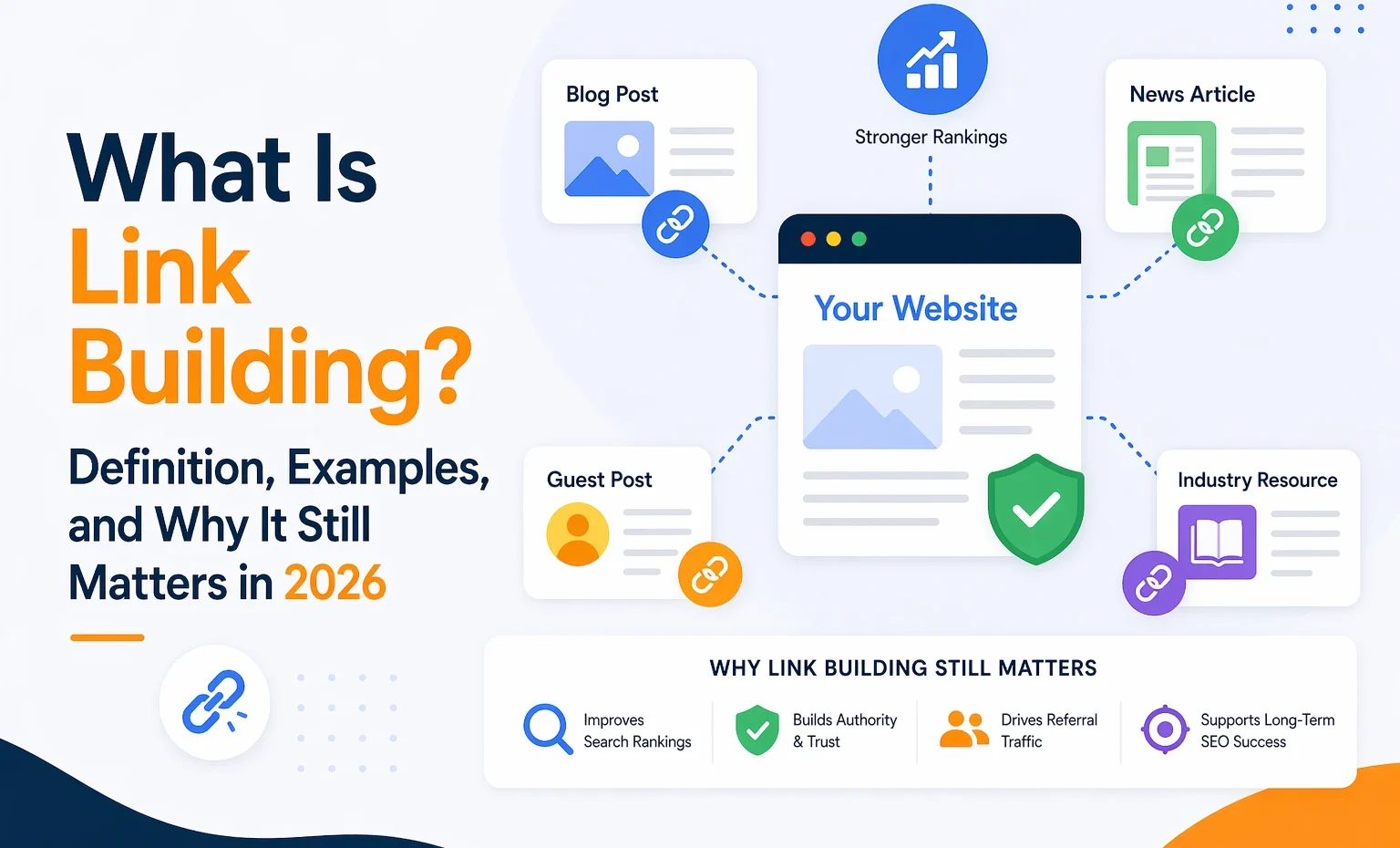
What Is Link Building? Definition, Examples, and Why It Still Matters in 2026
Does your website feel hidden on Google? Are you making good stuff, but no one is visiting? Your problem might be your link profile. If you want to get your website to the top of Google, it’s still all about link building. It is like a popularity contest: when other websites link to yours, it’s a “vote” that tells Google your site is trustworthy and worth showing to people. If you want your website to rank higher in 2026, this guide will teach you what link building is, why it’s so important, and how you can do it well.
What Is Link Building?
Link building is all about getting other websites to add links that go to your site. A hyperlink is just a word or picture you can click on that sends you to a different page. You can think of a link as a road from one website to yours.
There are two main categories:
- Internal links: Connect pages within your site.
- Outbound (external) links: Point from your site to another website.
- Inbound links (backlinks): Come from another site and point to yours. These act as “votes of confidence” that tell Google your content is trustworthy.
Each link also has anchor text (the clickable words), which tells Google what the linked page is about.
Google uses all of these links to understand how websites relate to each other and decide which pages deserve higher rankings.
Why Link Building Still Matters in 2026
Even though Google algorithms look at many things, like whether your website has good information, is easy to use, and E-E-A-T (Experience, Expertise, Authoritativeness, and Trustworthiness), backlinks are still very important.
Let us tell you why:
- Google still uses links as a way to trust your website. Links are votes. A link from a good site is a vote for your content.
- Links build your reputation. If you get a good link from a well-known site, it tells Google that your information is good (topical Authority).
- Links are here to stay. They help your site be seen as an authority. The more quality links you get from similar websites, the more Google sees you as an expert on that topic. Links are still a significant part of ranking high in 2026.
Types of Links You Need to Know
Not all links are created equal. They are like recommendations. Search engines judge links differently, so it’s important to know the main types:
- Natural Backlinks: These are the best kind! They happen when someone links to your site because they genuinely like your content, like a blogger linking to your study.
- Outreach Backlinks: You get these links by asking for them. This includes things like writing a guest blog post for another website and including a link back to your site.
- Self-Created Links: These are links you make yourself, like in a blog comment or a business directory. These aren’t as powerful and can be risky if you make too many of them.
- DoFollow Links: These are the links that actually help your SEO and make your website stronger in Google’s eyes.
- NoFollow Links: These links don’t help your SEO directly, but they can still bring visitors to your site and make your link profile look more natural.
The best links are relevant, come from a trusted website, and are placed naturally inside a page’s main content.
White-Hat vs Black-Hat Link Building
When you try to get other sites to link to yours, you can do this in two main ways: the right way (white-hat) or the wrong way (black-hat). If you want your website to do well for a long time, you need to know the difference.
White-hat link building
If you want to get links the honest way, it means your site is so good that people truly want to share it. Here’s how it’s done:
- Outreach to relevant websites
- Guest posting and contributing expert insights
- Creating link-worthy resources (guides, research, tools)
- Digital PR and earning media mentions
Black-hat link building
When you use the cheating way to get links, you’re trying to trick Google so your site ranks higher. For Example:
- Buying or exchanging links
- Using link farms or automated link schemes
- Building private blog networks (PBNs)
Effective Link Building Strategies in 2026 (with Examples)
If you want links to your website in 2026, it is about quality, not quantity. It’s about earning links from good websites by being helpful. Here are the best ways to get links:
- Guest posting: Write a helpful article for a popular website in your field and include a link to your site.
- Create great content: Make a useful guide, new research, or a free tool that people will want to link to on their own.
- Fix broken links: Find old, broken links on other websites and suggest your content as a replacement.
- Digital PR: Share interesting information or new data with news sites to get mentioned and linked.
- HARO (Help a Reporter Out): Give quotes to journalists who need an expert. In return, they’ll link to your website.
- Sponsorships: Support an event or charity that will list your website on their page
The best way to get links is to earn them by providing something valuable and relevant. So, don’t look for easy ways to get links. Instead, create something people will want to link to.
How to Identify High-Quality Backlinks
Have you ever wondered what makes one backlink so much more valuable than another? It’s all about quality over quantity. But what makes a backlink good? Think of a backlink as a vote of confidence for your website. A vote from a trusted expert is worth much more than a vote from a complete stranger. When you’re trying to get backlinks, you want to get votes from websites that are:
- Relevance: Is it from a friend? The website that links to you should be on the same topic. If you have a website about gardening, a link from a gardening blog is a good “friend.” A link from a car repair website is not.
- Authority: Is it from someone important? The link should come from a popular, trusted website. A recommendation from a famous expert is much better than one from a random person.
- Anchor text variety: Does it sound normal? The words used for the link should make sense in the sentence. They shouldn’t be the same words repeated again and again.
- Good placement: Is it in the right place? The link should be in the main part of an article or story, not hidden at the bottom of the page or on the side.
Common Link Building Mistakes to Avoid
Are you sure all your backlinks are helping your site? Just as some links help your site, others can actually hurt it, and others can be very bad for it. Here are some things you should never do:
- Using the same words over and over. The words you use for a link should be different each time. If you link 20 times with the same phrase, like “best SEO agency,” Google might think it looks fake.
- Buying links from bad places. Never pay for links from weird or spammy websites. They will hurt your site more than they help.
- Only doing one thing. Your links should come from different places and in different ways. If you only use one method, like writing guest posts, it looks strange.
- Forgetting your own links. It’s easy to focus on getting links from other sites, but you should also make sure the pages on your own website are linked to each other. This is a very easy way to make your site stronger.
If you want to make your website safe and successful, build links in a natural, honest way.
Link Building vs Content Marketing
Why don’t all good articles get noticed? It’s because link building works best when combined with strong content.
- Content Marketing is like throwing a great party. You create something amazing that people want to be a part of, like a fun blog post or a helpful guide.
- Link Building is like inviting people to the party. You actively reach out to others and ask them to tell their friends about it by linking to your site.
You need both to succeed. If you throw a great party but don’t invite anyone, no one will come. And if you invite everyone to a boring party, they won’t want to tell their friends. Both are needed for long-term SEO success.
Measuring Link Building Success
Is your website getting stronger because of all your hard work? If you want to track results, use tools like Ahrefs, Semrush, Moz, or Google Search Console.
- Is your website getting more popular? Think of your website’s strength score (like Domain Authority or Domain Rating). When good websites link to you, this score goes up, showing that your site is becoming more trusted and popular.
- Are more new friends linking to you? Count the number of different websites that have a link to your site. Getting links from many different websites is a great sign that your site is becoming a trusted source of information.
- Are you getting noticed on Google? Look at your rankings. If your pages are moving higher in Google’s search results, it means your links are helping you get noticed by more people.
- Are people actually clicking your links? See if people are visiting your website by clicking on a link from another site. This is called referral traffic. It’s proof that your links are not just for search engines, but are also bringing real visitors to your site.
By checking these four things, you can easily tell if your link building is a success.
The Future of Link Building Beyond 2026
Will link building still matter in the future? The answer is yes, but it will change a little. Here’s what’s coming after 2026:
- Mentions matter. If another website talks about your brand, it’s like a vote of confidence, even if they don’t link to your site.
- Will getting one good link be better than ten bad ones? Absolutely. A link from a trusted expert website will be worth a lot more than many links from sites that aren’t very important.
- Will AI make links useless? No. AI still needs links. As search gets smarter with AI, links will still be needed to prove that your website is real and a place people can trust.
The future of link building is not about getting a ton of links. It’s about getting links that show you are a real expert.
Final Words
Does link building even matter anymore? The answer is a clear yes. But with a few important changes. The biggest change is that quality is now far more important than quantity. If you get one strong link from an expert website, it is worth much more than many weak links from random sites. You also need to make sure your links are a good fit, coming from websites related to your topic. When you do things honestly and focus on a few great links while also creating fantastic content on your own website, you can easily improve your site’s visibility and earn more trust from both people and search engines.
