

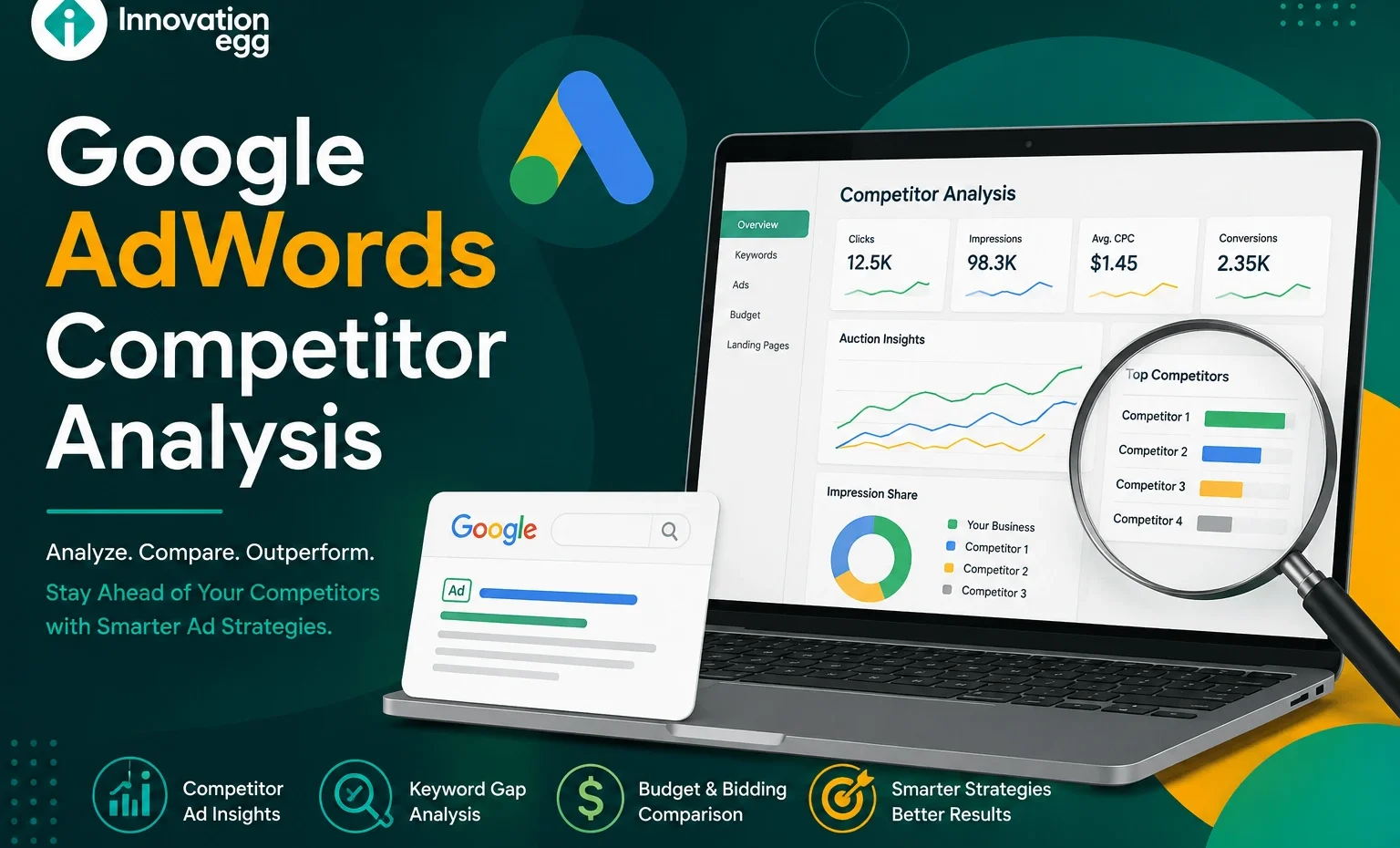
Google AdWords Competitor Analysis: The Complete Guide to Outranking Your Rivals in 2026
Running Google Ads without understanding your competitors is like entering a race without knowing who you’re competing against. While creating good ads and selecting the right keywords are important, knowing how your competitors attract clicks and conversions can give you a major advantage.
Although the platform is now officially called Google Ads, many businesses still search for Google AdWords competitor analysis, making it an important topic for marketers in 2026.
Competitor analysis helps you discover which keywords your rivals target, how they write persuasive ads, which landing pages convert visitors, and where you can outperform them. Instead of copying competitors, the goal is to learn from their strengths and identify opportunities they have missed.
In this guide, you’ll learn practical strategies, proven tools, and expert tips to improve your campaigns and make smarter advertising decisions.
What Is Google AdWords Competitor Analysis?
Google AdWords competitor analysis is the process of researching other advertisers that compete for the same audience on Google Ads.
Rather than guessing what might work, you use real data to understand:
- Keywords competitors target
- Their ad headlines and descriptions
- Landing page strategies
- Promotional offers
- Estimated advertising activity
- Audience targeting
- Overall campaign strengths and weaknesses
This information helps you build stronger campaigns while avoiding costly mistakes.
Why Competitor Analysis Is Important
Many advertisers spend thousands of dollars on Google Ads without ever looking at what their competitors are doing.
That usually leads to:
- Higher CPC
- Lower Quality Score
- Weak ad copy
- Poor landing pages
- Missed keyword opportunities
Competitor analysis helps you:
- Find profitable keywords
- Improve ad relevance
- Increase click-through rates
- Lower advertising costs
- Discover untapped markets
- Improve conversions
- Build better landing pages
The result is a campaign based on data rather than assumptions.
How Google Ads Competition Works in 2026
Before analyzing competitors, it’s important to understand how Google decides which ads appear.
Ad Rank
Google doesn’t simply show the advertiser with the highest bid.
Instead, Ad Rank considers several factors:
- Maximum bid
- Expected click-through rate
- Ad relevance
- Landing page experience
- Ad extensions
- User intent
A highly relevant ad can often beat a competitor with a larger budget.
Quality Score
Quality Score remains one of the biggest ranking factors.
Google evaluates:
- Expected CTR
- Ad relevance
- Landing page experience
Improving these areas often lowers your cost per click while increasing visibility.
AI-Powered Smart Bidding
Google now relies heavily on artificial intelligence.
Strategies such as:
- Maximize Conversions
- Target CPA
- Target ROAS
- Maximize Conversion Value
automatically adjust bids based on thousands of real-time signals.
This makes competitor monitoring even more valuable, as advertisers are constantly optimising their campaigns.
Who Are Your Real Competitors?
One of the biggest mistakes businesses make is assuming their business competitors are the same as their Google Ads competitors.
That isn’t always true.
For example:
A local plumber may compete with:
- National lead-generation websites
- Home service directories
- Emergency repair companies
- Local plumbing businesses
Your real competitors are the advertisers appearing for the same search queries.
How to Identify Google Ads Competitors
A simple process includes:
1. Search Your Primary Keywords
Search your target keywords in Google.
Notice:
- Which companies appear repeatedly
- Which offers stand out
- Which headlines attract attention
2. Review Google Ads Auction Insights
If you’re already running campaigns, Auction Insights shows:
- Impression Share
- Overlap Rate
- Position Above Rate
- Top of Page Rate
This is one of the most reliable ways to identify direct competitors.
3. Use PPC Intelligence Tools
Professional marketers also use tools that reveal:
- Competitor keywords
- Ad history
- Landing pages
- Estimated traffic
- Paid search visibility
We’ll cover these tools next.
Best Tools for Google AdWords Competitor Analysis
Different tools provide different insights.
| Tool | Best For | Free Version |
| SEMrush Advertising Research | Competitor keywords & ads | Limited |
| SpyFu | PPC history | Limited |
| Ahrefs | Keyword research | No |
| Google Auction Insights | Live competitors | Yes |
| Similarweb | Traffic estimates | Limited |
| iSpionage | PPC intelligence | Trial |
Using two or three tools together usually provides a more complete picture.
How to Analyze Competitor Keywords
Keywords are the foundation of every successful Google Ads campaign.
When researching competitors, focus on four areas.
High-Converting Keywords
Look for keywords competitors consistently advertise.
If an advertiser has used the same keyword for months, there’s a good chance it generates profitable results.
Commercial Intent Keywords
Prioritize keywords that indicate buying intent.
Examples include:
- buy
- pricing
- services
- near me
- quote
- best
These typically produce higher conversion rates.
Long-Tail Keywords
Long-tail keywords often have:
- Lower CPC
- Less competition
- Higher conversion rates
For example:
Instead of targeting
SEO services
consider
SEO services for small law firms
Specific keywords often produce better ROI.
Keyword Gap Analysis
One of the easiest ways to outperform competitors is by identifying keywords they aren’t targeting.
Ask yourself:
- Are there local searches they’re missing?
- Are there industry-specific keywords they’ve ignored?
- Are there informational keywords that could bring future customers?
Finding these gaps can uncover profitable opportunities with less competition.
How to Analyze Competitors’ Ads
Competitor ads reveal what attracts customers.
Don’t copy them.
Instead, study what consistently appears.
Focus on:
Headlines
Look for repeated phrases.
Examples:
- Free Consultation
- Same-Day Service
- 24/7 Support
- Certified Experts
If similar messaging appears repeatedly, it’s likely working.
Descriptions
Notice how competitors explain benefits.
Strong ads focus on customer outcomes rather than company features.
Compare these examples:
Wrong: We have 20 years of experience.
Correct: Get expert help that saves time and reduces costs.
Benefits usually outperform features.
Calls-to-Action
Pay attention to CTAs like:
- Get Started
- Request a Quote
- Book Today
- Schedule Your Demo
- Try It Free
Effective CTAs encourage immediate action.
Promotions
Many successful advertisers include:
- Free shipping
- Limited-time discounts
- Money-back guarantees
- Free consultation
- No setup fees
Offers often improve click-through rates significantly.
How to Evaluate Competitor Landing Pages
Getting the click is only half the battle.
The landing page determines whether visitors convert.
When reviewing competitor pages, ask these questions:
Is the headline clear?
Visitors should immediately understand the offer.
Is there a strong call-to-action?
Buttons should be easy to find and action-oriented.
Examples:
- Get Started
- Book a Call
- Request Pricing
Does the page build trust?
Look for:
- Customer reviews
- Testimonials
- Certifications
- Awards
- Security badges
- Case studies
These elements reduce hesitation and increase conversions.
Is the page mobile-friendly?
Most Google Ads traffic now comes from mobile devices.
A slow or poorly designed mobile page can waste ad spend.
Landing Page Checklist
Before publishing your own landing page, ensure it includes:
- Clear headline
- Fast loading speed
- Strong CTA
- Customer testimonials
- Benefits instead of features
- Mobile optimization
- Simple contact form
- Trust signals
A well-optimized landing page often has a greater impact on conversions than increasing your advertising budget.
Understanding Competitor Bidding Strategies
Google doesn’t reveal the exact amount your competitors bid, but you can estimate how aggressive they are by studying their advertising behavior.
Look for these signals:
- Ads appearing consistently at the top of search results
- High Impression Share in Auction Insights
- Frequent appearances for competitive keywords
- Ads running throughout the day
- Long-running campaigns
If a competitor has maintained visibility for months, they’re likely investing in keywords that generate profitable results.
Instead of trying to outbid everyone, focus on improving your ad relevance and landing page experience. A higher Quality Score often lets you rank above competitors while paying less per click.
Monitor Competitors Regularly
Google Ads change quickly.
A competitor may launch:
- New promotions
- Seasonal offers
- Different landing pages
- Updated ad copy
- New keyword targeting
Checking competitors once isn’t enough.
Create a monthly routine to review:
- New advertisements
- Keyword changes
- Pricing updates
- Landing page improvements
- Customer reviews
- New offers
Small improvements made consistently often produce better results than occasional major changes.
Competitor Analysis for Local Businesses
If you run a local business, your competitors are usually businesses within your service area.
Pay attention to:
- Location-specific keywords
- Google Business Profile optimization
- Customer ratings
- Local promotions
- Business hours
- Click-to-call buttons
- Location extensions
For example, if you’re a dentist in Chicago, your competitors are not every dentist in the country. They’re the advertisers targeting searches like:
- Dentist near me
- Emergency dentist Chicago
- Family dentist Chicago
Local competitor research often reveals opportunities national advertisers miss.
Competitor Analysis for E-commerce Campaigns
Online stores should evaluate more than keywords.
Study:
- Product pricing
- Shopping Ads
- Product titles
- Product descriptions
- Promotions
- Free shipping offers
- Customer reviews
- Product images
Sometimes, a better product image or stronger offer generates more clicks than increasing your advertising budget.
2026 Google Ads Trends You Should Know
Google Ads continues to evolve with the help of artificial intelligence.
Here are some trends shaping campaigns in 2026.
AI-Powered Campaign Optimization
Machine learning now influences bidding, audience targeting, and ad delivery more than ever.
Successful advertisers review AI recommendations but still make strategic decisions themselves.
Performance Max Campaigns
Performance Max campaigns continue expanding across:
- Search
- Display
- YouTube
- Gmail
- Discover
- Maps
Competitor research now extends beyond traditional Search campaigns.
First-Party Data
As privacy regulations evolve, advertisers increasingly rely on:
- Customer lists
- CRM data
- Website visitors
- Email subscribers
Building your own audience has become a competitive advantage.
A Simple Competitor Analysis Workflow
Use this workflow each month:
| Step | Action |
| 1 | Search your target keywords |
| 2 | Identify recurring advertisers |
| 3 | Review Auction Insights |
| 4 | Analyze competitor ads |
| 5 | Visit landing pages |
| 6 | Find keyword gaps |
| 7 | Compare offers |
| 8 | Improve your own campaigns |
| 9 | Measure results |
| 10 | Repeat monthly |
Consistency is far more valuable than doing a large analysis only once a year.
Real-World Example
Imagine two software companies advertising project management tools.
Company A spends more money but uses generic headlines like:
Best Project Management Software
Company B researches competitors and discovers users respond better to benefit-focused messaging.
Their headline becomes:
Manage Projects 40% Faster with AI Automation.
They also improve their landing page by adding:
- Customer testimonials
- Free trial
- Comparison chart
- Faster page speed
- Clear call-to-action
Even without increasing bids, Company B achieves:
- Higher click-through rate
- Better Quality Score
- Lower CPC
- More conversions
This demonstrates why competitor analysis is about making smarter decisions, not simply spending more.
Common Mistakes to Avoid
Many advertisers make these costly mistakes.
Copying Competitors
Learn from competitors but create unique ads that highlight your own value.
Focusing Only on Keywords
Keywords matter, but so do:
- Ad relevance
- Landing page experience
- Offers
- User experience
Ignoring Mobile Users
Most Google Ads traffic now comes from smartphones.
Always test your landing pages on mobile devices.
Never Reviewing Campaigns
Competitor analysis should be ongoing.
Markets change constantly.
Chasing Every Competitor
Focus on your strongest competitors rather than trying to monitor every advertiser.
Expert Tips
- Review Auction Insights every month.
- Test one new ad variation each week.
- Update landing pages regularly.
- Track competitors over time rather than relying on a single snapshot.
- Focus on improving Quality Score before increasing bids.
- Keep testing headlines, descriptions, and calls to action.
Small improvements across multiple areas usually produce the biggest long-term gains.
How Professionals Use Competitor Analysis
Many successful Digital marketing Agencies make competitor research part of every campaign before spending a client’s advertising budget.
Likewise, experienced B2B SEO Consultants often combine paid search insights with organic keyword research because understanding ppc in seo helps businesses discover opportunities across both advertising and search engine optimization strategies.
Instead of treating SEO and PPC as separate channels, high-performing marketers use data from both to build stronger digital marketing campaigns.
Google AdWords Competitor Analysis Checklist
Before launching your next campaign, make sure you’ve completed each of these steps.
- Identified your main competitors
- Reviewed Auction Insights
- Found profitable keywords
- Discovered keyword gaps
- Studied competitor headlines
- Compared landing pages
- Evaluated offers and promotions
- Improved your Quality Score
- Tested multiple ad variations
- Monitored campaign performance
Save this checklist and repeat it regularly to stay ahead of the competition.
Conclusion
Google AdWords competitor analysis is no longer optional for businesses that want to succeed in 2026. As competition increases and advertising costs continue to rise, understanding how your competitors attract customers can help you make smarter decisions, improve campaign performance, and reduce wasted ad spend.
The goal isn’t to copy others; it’s to learn from the market and build campaigns that offer a better experience for your audience. By regularly researching competitor keywords, analyzing ad copy, reviewing landing pages, and monitoring Auction Insights, you can uncover valuable opportunities that others overlook. Businesses that also invest in professional PPC services can use these insights to optimize campaigns more effectively and maximize their advertising return.
Remember that successful Google Ads campaigns are built through continuous testing and optimization. Make competitor analysis a regular part of your strategy, measure your results, and refine your campaigns over time. Businesses that consistently learn, adapt, and improve are most likely to stay ahead of the competition and achieve long-term success.
Frequently Asked Questions
What is Google AdWords competitor analysis?
It is the process of researching competitors’ Google Ads campaigns to understand their keywords, advertisements, landing pages, and marketing strategies so you can improve your own campaigns.
Is competitor analysis legal?
Yes. It involves studying publicly available information and using approved advertising tools. You should never attempt to access private competitor accounts or confidential data.
Which tool is best for competitor analysis?
Google Auction Insights is excellent for advertisers already running campaigns. For broader research, tools such as SEMrush, SpyFu, and Similarweb provide additional keyword and advertising insights.
How often should I analyze competitors?
A monthly review is recommended for most businesses. In highly competitive industries, weekly monitoring may provide an advantage.
Can I see my competitors’ exact advertising budget?
No. Google does not reveal exact budgets, although several marketing tools provide estimated spending and traffic data.
What should I analyze first?
Start with competitor keywords, ad copy, landing pages, and Auction Insights. These areas often have the biggest impact on campaign performance.
Does competitor analysis improve Quality Score?
Indirectly, yes. Better keywords, more relevant ads, and improved landing pages can all contribute to a higher Quality Score.
Should I copy my competitors’ ads?
No. Use competitor research for inspiration, then create original ads that clearly communicate your own unique value.
