

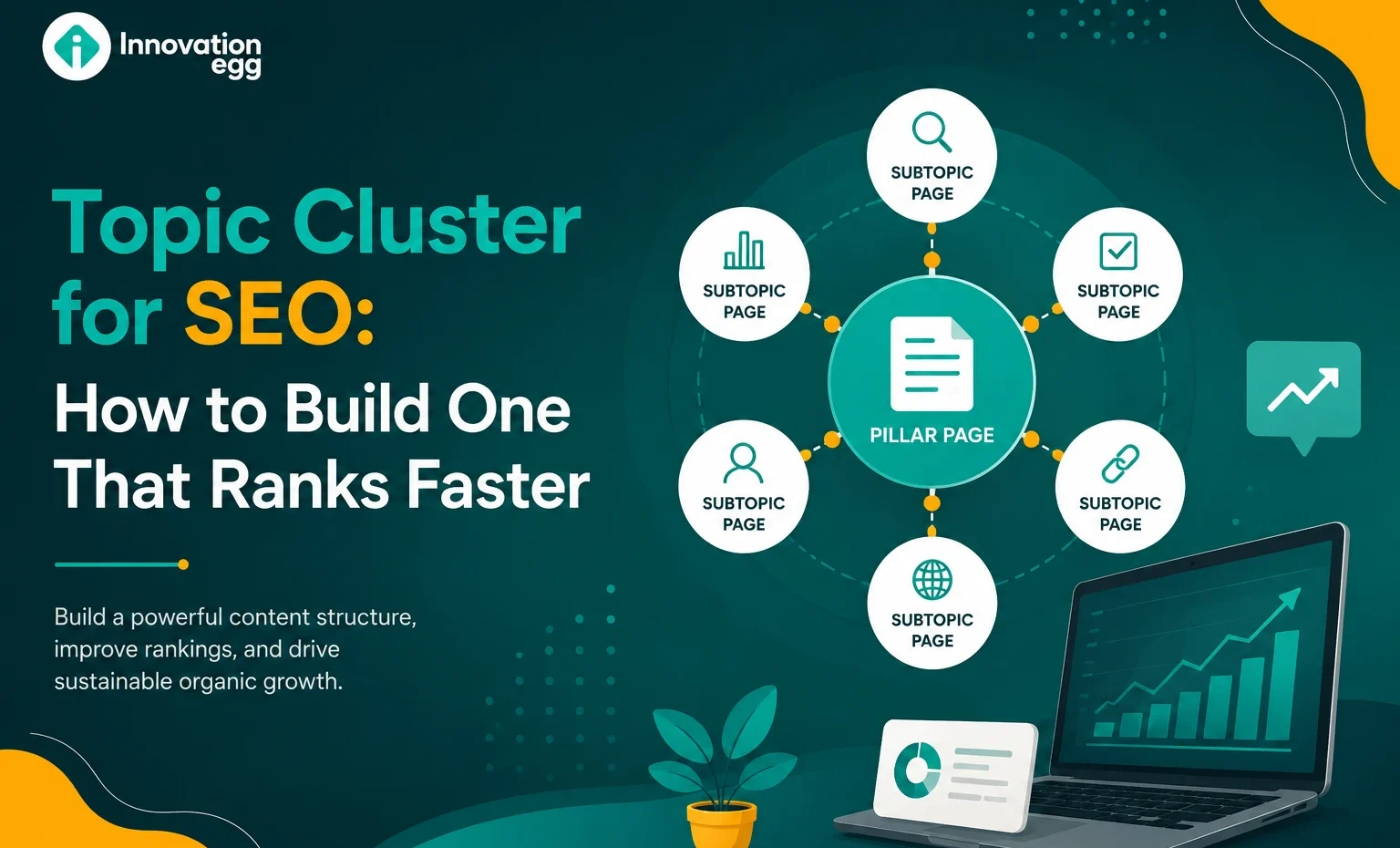
Topic Cluster for SEO: How to Build One That Ranks Faster
SEO has changed dramatically over the past decade. Early on, websites ranked by repeating a single keyword. Businesses emphasized keyword density, exact-match phrases, and backlinks, neglecting user experience and content depth.
Today, search engines — especially Google — are much smarter. SEO is no longer about one page and one keyword. Instead, engines now assess how well a site covers an entire topic. This shift means that sites with comprehensive coverage are rewarded with better rankings and greater visibility.
Topic clusters play a vital role in this new SEO landscape.
A topic cluster is an effective SEO strategy for building authority and ranking faster. Instead of posting unrelated articles, clusters organize your content around a main subject.
In this guide, you’ll learn:
- What a topic cluster is
- Why topic clusters improve rankings faster
- How to create a pillar page and supporting content
- The exact process to build a high-performing cluster
- Common mistakes to avoid
- Advanced SEO strategies for faster results
- A complete keyword map example you can apply to your own niche
For long-term SEO growth, topic clusters are essential.
What Is a Topic Cluster in SEO?
A topic cluster is a content strategy in which several related articles connect to a single main topic. It creates a network that helps search engines recognize your expertise.
A topic cluster usually consists of three major components:
- Pillar content
- Cluster content
- Internal linking
Here is a breakdown of these components.
Pillar Content (Main Topic Page)
A pillar page is the hub of the cluster. It covers a broad topic in detail and links to related articles.
For example:
Pillar Topic: SEO Strategy
The pillar page provides a complete overview of the SEO strategy while linking to more detailed articles, like:
- Keyword research
- On-page SEO
- Technical SEO
- Link building
- SEO analytics
The pillar page targets broad, high-volume keywords.
Cluster Content (Supporting Subtopics)
Cluster content covers subtopics related to the pillar page.
These articles target long-tail keywords and detailed questions.
Examples include:
- How to do keyword research
- Best on-page SEO checklist
- Technical SEO basics for beginners
- Link-building strategies for startups
Each cluster article reinforces the pillar page and boosts topical relevance.
Internal Linking Structure
Internal linking connects the entire topic cluster.
The structure works like this:
- Pillar page links to all cluster pages
- Cluster pages link back to the pillar page.
- Cluster pages may also link to related cluster articles.
This forms a strong content network that improves crawling and SEO authority.
Why Topic Clusters Help You Rank Faster
Topic clusters are powerful because they align with how modern search engines evaluate websites.
Several factors contribute to their effectiveness.
Builds Strong Topical Authority
Covering a subject well signals to search engines that your site is a trusted resource.
Google sees an entire ecosystem focused on one topic, not isolated posts.
This raises your authority and ability to rank for more keywords.
Improves Crawlability for Search Engines
Search engine bots use links to discover and understand content.
A well-structured cluster connects pages logically, making crawling easier.
This speeds up indexing and helps new pages get found faster.
Increases Internal Linking Signals
Internal links pass authority between pages.
When cluster articles link to the pillar page, they boost the pillar page’s SEO value.
This boosts relevance and ranking signals throughout your site.
Covers Search Intent More Completely
Users search in different ways.
Some users want basics, others advanced tips.
Topic clusters help you address:
- Informational intent
- Commercial intent
- Transactional intent
- Navigational intent
Covering every angle increases your chances of ranking for more searches.
Reduces Keyword Cannibalization
Keyword cannibalization is when pages compete for the same keyword.
Topic clusters prevent this by assigning:
- One primary keyword per page
- Specific search intent per article
- Clear topical relationships
This makes your SEO strategy more organized and effective.
Core Elements of a High-Performing Topic Cluster
4.1 Pillar Page
The pillar page is the foundation of your topic cluster.
A strong pillar page should:
- Cover a broad topic comprehensively.
- Target high-search-volume keywords
- Act as the central hub
- Include links to all supporting articles.
Think of it as the “ultimate guide” for a topic.
Example Pillar Topics
- SEO Strategy
- Content Marketing
- Email Marketing
- Social Media Marketing
- E-commerce SEO
The goal is depth without overwhelming detail.
4.2 Cluster Content Pages
Cluster pages support the pillar page by focusing on narrow topics.
These pages should:
- Target long-tail keywords
- Solve specific user problems.
- Answer frequently asked questions.
- Provide actionable insights
Each article should focus on one main keyword and one user intent.
Examples
For a pillar page about “SEO Strategy,” cluster pages may include:
- How to find low-competition keywords
- SEO audit checklist
- Image optimization for SEO
- Local SEO ranking factors
This structure creates comprehensive topic coverage.
4.3 Internal Linking Structure
Internal linking is the backbone of a topic cluster.
A proper linking structure should:
- Link every cluster article back to the pillar page.
- Link the pillar page to all cluster pages.
- Add contextual links between related articles.
This improves:
- User navigation
- Crawl efficiency
- SEO authority distribution
Without strong internal linking, topic clusters lose effectiveness.
Step-by-Step: How to Build a Topic Cluster That Ranks Faster
Step 1: Choose a Core Topic (Pillar Topic)
Start with a broad topic that has:
- Strong search demand
- Business relevance
- Multiple subtopics
- Long-term content potential
Your pillar topic should align with your products, services, or audience interests.
Good Pillar Topic Examples
- Digital Marketing
- Technical SEO
- WordPress SEO
- SaaS Marketing
- Content Strategy
Avoid topics that are too narrow because they limit cluster opportunities.
Step 2: Do Keyword Research
Keyword research is the foundation of your cluster strategy.
You need to identify:
- Primary keywords
- Long-tail keywords
- Related questions
- Semantic keywords
- User intent variations
Keyword Research Sources
- Google autocomplete
- People Also Ask
- SEO tools
- Competitor analysis
- Search console data
Group keywords by intent and topic relevance.
Step 3: Create Pillar Content First
Your pillar page should be a comprehensive resource.
The ideal pillar page:
- Covers the topic broadly
- Includes clear sections
- Uses easy-to-read formatting
- Links to supporting content
- Answers major questions
Think of it as the homepage for that topic.
A well-optimized pillar page can become a major traffic driver over time.
Step 4: Build Supporting Cluster Content
Next, create detailed cluster articles.
Each article should:
- Target one primary keyword
- Address one major problem.
- Include practical examples
- Add value beyond competitors.
This strategy creates highly focused pages that rank for specific searches.
Example
Pillar Topic: SEO Strategy
Cluster Articles:
- Beginner’s guide to keyword research
- Technical SEO checklist
- On-page SEO mistakes
- Link-building outreach templates
Each article strengthens the main topic.
Step 5: Add Strong Internal Links
Internal linking is critical.
Your linking structure should look like this:
Cluster → Pillar
Every supporting article links back to the pillar page.
Pillar → Cluster
The pillar page links to all supporting articles.
Cluster ↔ Cluster
Related articles should link to one another naturally.
This creates a strong SEO relationship between all pages.
Step 6: Optimize for Search Intent
Search intent determines whether users find your content useful.
There are four primary intent types:
Informational Intent
Users want information.
Example:
“How does technical SEO work?”
Navigational Intent
Users want a specific website or page.
Example:
“SEO audit tool login”
Transactional Intent
Users are ready to buy.
Example:
“Hire SEO consultant”
Commercial Investigation
Users compare solutions before buying.
Example:
“Best SEO tools for agencies”
Aligning your content with search intent improves rankings and engagement.
Example of a Topic Cluster (Practical Case Study)
Let’s look at a practical example.
Pillar Topic: SEO Strategy
This pillar page covers:
- SEO fundamentals
- Keyword research
- Technical SEO
- Link building
- Content optimization
- Analytics
Target Keyword
“SEO strategy”
Cluster Content Plan (Full Keyword Map)
| Keyword Research Guide | keyword research guide | Informational |
| On-Page SEO Checklist | on-page SEO checklist | Informational |
| Technical SEO Basics | technical SEO basics | Informational |
| Link Building Strategies | link building strategies | Informational |
| SEO Audit Process | SEO audit checklist | Informational |
| Local SEO Tips | local SEO tips | Informational |
| SEO Tools Comparison | best SEO tools | Commercial |
| SEO Reporting Guide | SEO reporting template | Informational |
| SEO for Beginners | beginner SEO guide | Informational |
| Content Optimization Tips | content optimization SEO | Informational |
Internal Linking Example
The pillar page links to every supporting article.
Each cluster article includes:
- A link back to the main SEO strategy guide
- Links to related cluster pages
This creates a strong topic ecosystem that improves rankings over time.
Common Mistakes to Avoid
Many websites fail with topic clusters because they ignore strategic planning.
Here are the most common mistakes.
Creating Clusters Without Keyword Research
Publishing random articles without keyword mapping creates weak topical relevance.
Always research keywords before creating content.
Weak or Missing Internal Linking
Without internal links, search engines cannot fully understand the relationships between pages.
Every cluster page must connect logically.
Targeting the Same Keyword on Multiple Pages
This causes keyword cannibalization.
Assign one primary keyword per page.
Keep search intent unique.
Writing Thin Cluster Content
Short, low-quality articles weaken the entire cluster.
Every cluster page should provide substantial value and depth.
How Topic Clusters Improve Google Rankings Faster
Topic clusters accelerate rankings by simultaneously strengthening multiple SEO signals.
Faster Indexing Through Linked Structure
Search engines discover linked pages faster.
This helps new content get indexed more efficiently.
Higher Authority Signals Over Time
As your cluster grows, your topical authority strengthens.
This improves your ability to rank for competitive keywords.
Better User Engagement Metrics
Users spend more time exploring related content.
This improves:
- Session duration
- Pages per visit
- Bounce rate
- User satisfaction
Strong engagement signals support better rankings.
Increased Chances of Ranking for Multiple Keywords
One cluster can rank for hundreds of related searches.
This creates compound traffic growth over time.
Businesses offering the best SEO services in the USA often use topic clusters to dominate competitive search categories because the strategy efficiently scales authority.
Advanced Strategies to Boost Ranking Speed
Once your basic topic cluster is built, advanced optimization can improve results even faster.
Use Semantic Keywords (LSI Terms)
Semantic keywords help search engines understand context.
Examples for SEO strategy include:
- Organic traffic
- Search rankings
- Content optimization
- SERP visibility
- Search engine algorithms
These terms improve topical relevance naturally.
Add FAQ Sections in Cluster Pages
FAQ sections help answer additional user questions.
Benefits include:
- Better user experience
- More keyword coverage
- Increased featured snippet opportunities
FAQs can also improve voice search visibility.
Optimize for Featured Snippets
Featured snippets appear at the top of search results.
To improve your chances:
- Use concise answers
- Add numbered lists
- Include definitions
- Structure headings clearly
Snippet optimization can dramatically increase click-through rates.
Update Content Regularly
Fresh content performs better in competitive industries.
Regular updates help maintain:
- Accuracy
- Relevance
- Rankings
- User trust
Refreshing old cluster pages can produce significant ranking improvements.
Use Schema Markup for SEO Enhancement
Schema markup helps search engines better understand your content.
Useful schema types include:
- FAQ schema
- Article schema
- Breadcrumb schema
- How-to schema
Structured data can improve visibility in search results.
Conclusion
Topic clusters have become one of the most effective SEO strategies for improving rankings, increasing authority, and building long-term organic traffic.
Instead of creating disconnected blog posts, topic clusters organize content into a structured ecosystem that search engines can easily understand.
By combining:
- Strong pillar pages
- High-quality cluster content
- Strategic internal linking
- Search intent optimization
You create a scalable SEO framework that supports faster rankings and stronger visibility.
The biggest advantage of topic clusters is that they build long-term topical authority. As your cluster grows, your website becomes more trusted in search engines’ eyes, making it easier to rank for competitive keywords over time.
If you want sustainable SEO growth, start with one strong pillar topic, build supporting cluster pages around it, and connect everything strategically. Over time, this approach can transform your website into an authoritative resource within your industry.
